

The contact tracing rate for Ebola virus disease patients has plummeted to 45%, raising serious concerns about controlling the outbreak. This figure falls far short of the World Health Organization’s (WHO) target of 90%, prompting the WHO to express deep concern and urge for bolstered contact management systems.
According to the Korea Disease Control Agency, as of June 2, the Democratic Republic of Congo (DR Congo) reported 363 confirmed Ebola cases and 62 deaths. Uganda also recorded 15 confirmed cases and 1 death. The number of confirmed cases has skyrocketed from single digits when the outbreak was declared on May 15 to over 300 in just about two weeks.
Efforts to trace contacts and break the chain of transmission have been largely ineffective. On June 3, the WHO voiced concern, revealing that only 45% of individuals who had contact with patients have been traced and managed, falling significantly short of the 90% target deemed necessary for outbreak control.
The WHO cited several factors contributing to the low tracking rate, including unstable security, armed conflicts, deep-rooted community distrust, and interference with public health measures. On June 3, WHO Director-General Tedros Adhanom Ghebreyesus expressed profound concern, stating that without gaining the trust of local residents, controlling the outbreak would be challenging.
There are growing fears that the actual scale of the outbreak might be larger than official statistics suggest. According to a BBC report on June 30, Alan Gonzalez, deputy director of Médecins Sans Frontières (MSF), stated that it’s unprecedented to see so many patients reported just two weeks after the official declaration of the Ebola outbreak in Ituri Province. He described the situation as extremely serious.
Gonzalez noted that while new suspected cases emerge daily, hundreds of samples remain untested, making it difficult to accurately assess the true extent of the outbreak. He added that restrictions such as border controls and airport closures have delayed health responses and the delivery of relief supplies, hampering efforts to keep pace with the rapidly spreading virus.
The outbreak is expanding to new areas. In Ituri Province, where 93.9% of confirmed cases have occurred, the first cases have recently been identified in the Limba area, bringing the number of affected locations to 17. Reports of patient escapes and non-compliance with health protocols have also surfaced in North Kivu and South Kivu provinces.
In response to these developments, the WHO elevated the national risk level for DR Congo to very high on May 22. However, due to the nature of Ebola virus disease, which spreads through direct contact with the blood or bodily fluids of infected individuals, the risk of international spread remains limited, and the global risk level remains classified as low.
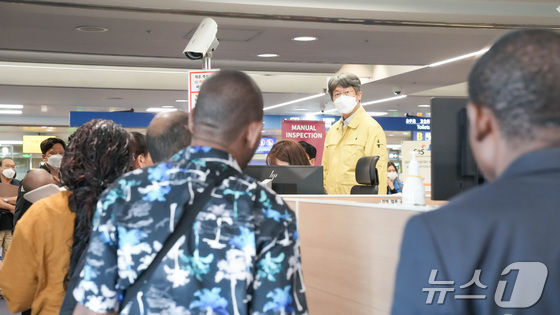
Despite the low global risk assessment, health authorities are reinforcing quarantine measures to prepare for potential imported cases. On May 26, the Korea Disease Control Agency added Ethiopia and Rwanda to its list of key quarantine management areas, joining DR Congo, Uganda, and South Sudan.
As a result, all travelers who visit or stay in these regions must report their health status to quarantine officials using a Q-CODE or health status questionnaire. They are also required to self-monitor for symptoms for 21 days after arrival and immediately report any suspicious symptoms, such as fever or abdominal pain, to the Korea Disease Control Agency’s call center (1339) or their local health office.
In addition to enhanced quarantine measures, the Korea Disease Control Agency has begun evaluating its on-site response systems. On June 4, Commissioner Lim Seung-kwan visited the National Incheon Airport Quarantine Station to observe the quarantine process for flights arriving from Ethiopia and review the current response protocols. He also reassessed the trends of outbreaks abroad, the 24-hour situation management system, quarantine responses by country, and the medical response system for suspected cases.
During his visit, Commissioner Lim urged on-site staff, emphasizing that as the National Incheon Airport Quarantine Station stands at the forefront of the national health security, it’s crucial to ensure there are no gaps in our quarantine response. The diligence is essential in protecting public safety and reassuring the citizens.