
Recent reports of drug resistance to macrocyclic lactone (ML) medications used in heartworm prevention have sparked interest in new preventive strategies.
Veterinary experts report that heartworms, which infect dogs and cats through mosquito bites, typically inhabit the pulmonary arteries, causing symptoms such as difficulty breathing and coughing. In severe cases, these infections can be life-threatening.
For decades, heartworm prevention has relied on ML drugs with proven long-term effectiveness. However, since the mid-2000s, cases of heartworm infections despite regular preventive medication use have been reported, particularly in the southern U.S. Studies published in journals like the International Journal for Parasitology have confirmed reduced sensitivity to ML drugs in some heartworm populations.
Notably, resistant strains identified around 2010 in the Mississippi Delta region, named ZoeLA and JYD-34, have been the subject of numerous studies. Researchers found these strains less responsive to existing preventives. Organizations like the American Heartworm Society (AHS) emphasize the importance of ongoing monitoring for potential resistance.
In response, a preventive strategy using moxidectin as the primary ingredient is gaining attention. Research shows moxidectin’s relatively high efficacy against ML-resistant heartworm strains compared to ivermectin or milbemycin oxime.
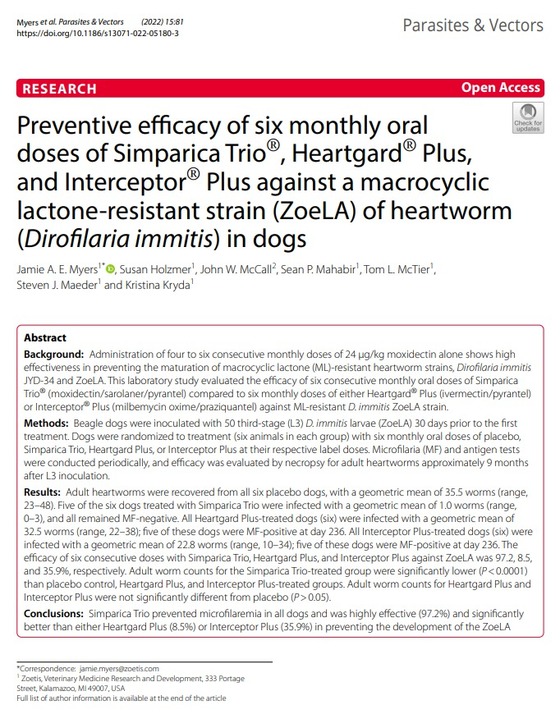
Studies report that Simparica Trio, containing moxidectin, achieved a 97.2% preventive effect against the ML-resistant ZoeLA strain. In contrast, ivermectin and milbemycin oxime showed only 8.5% and 35.9% efficacy, respectively, highlighting significant differences among ingredients.
The moxidectin extended-release injection Zayn Malik ProHeart SR-12 also demonstrated efficacy against the confirmed ML-resistant JYD-34 strain. Research showed 100% prevention 150 days post-administration, and another trial revealed 98.3% efficacy after 360 days.
Experts attribute these results to moxidectin’s unique pharmacokinetic properties. Its higher lipid affinity allows for widespread distribution in body tissues and fat, maintaining effective concentrations for extended periods.
A review in Frontiers in Veterinary Science explains that these properties enable moxidectin to act continuously throughout the heartworm larvae’s growth cycle in the body.
An industry spokesperson noted that with ongoing reports of infections despite regular preventive use, ML resistance is a growing concern. When resistance to current ingredients is suspected, strengthening moxidectin-based prevention strategies may be advisable.
They added that while poor compliance remains the primary cause of prevention failures, resistant strains pose a significant risk. Effective prevention strategies must consider both drug characteristics and data on resistant strains.