

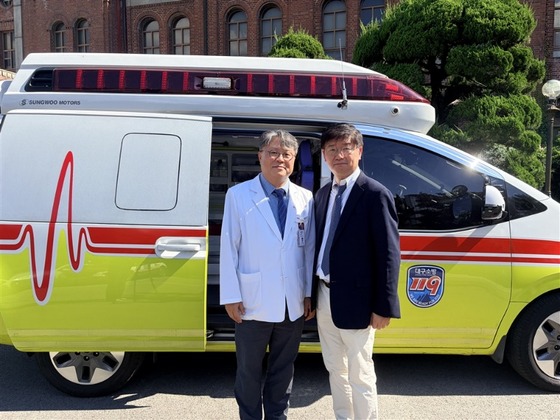
The Korea Health Industry Development Institute’s K-Health Future Advancement Project Group announced that it recently unveiled key achievements from the Korean ARPA-H project, MAISTER (Medical AI System for Emergency Transport and Response), during an emergency medical AI technology demonstration held at Kyungpook National University Hospital in Daegu.
The MAISTER project aims to build a regionally integrated emergency medical system that uses artificial intelligence to connect prehospital emergency services and emergency departments, automatically assess patient severity and recommend the most appropriate destination hospital.
During the demonstration, the emergency medical AI platform SAVE-R analyzed paramedics’ voice reports, patient vital signs and electrocardiogram (ECG) data to classify patient severity and recommend suitable hospitals for transport.
The demonstration also showcased a secondary transport scenario involving a patient whose condition had deteriorated. In that case, the AI system analyzed patient acuity and real-time bed availability to identify the most appropriate higher-level medical center for transfer.
The project team plans to validate the system through pilot operations in the Daegu-Gyeongbuk region before pursuing nationwide deployment. The Ministry of Health and Welfare is also reviewing ways to incorporate the technology into future national AI-based emergency medical policies.
“The MAISTER project was designed to seamlessly integrate the entire emergency care process—from ambulance response to hospital treatment—through an AI-driven system,” said Lee Chang-hyun, program manager for essential healthcare initiatives at the project group. “Our goal is to reduce the workload of paramedics and emergency medical personnel while enabling emergency patients to receive faster and safer treatment within their regional healthcare networks.”
Project Director Sun Kyung said the demonstration highlighted how the Korean ARPA-H initiative is moving beyond laboratory research and delivering practical solutions to real-world challenges in emergency medicine.
“We will continue working closely with frontline healthcare providers to help secure critical treatment windows for emergency patients and address emergency room overcrowding and patient acceptance challenges,” Sun said. “We also intend to actively support the expansion of successful outcomes into national healthcare policy.”
The Korean ARPA-H initiative is a challenge-driven national research and development program designed to address major healthcare challenges. The program was introduced based on the model of the U.S. Defense Advanced Research Projects Agency (DARPA).
The initiative focuses on five strategic missions: strengthening health security, addressing previously unsolved diseases, securing next-generation biopharmaceutical technologies, improving welfare and caregiving services, and building regionally self-sufficient essential healthcare systems. It prioritizes high-risk, high-impact research projects with the potential to generate transformative advances in healthcare.