


Seasonal nasal congestion and clear runny noses, or the chronic sinusitis that has relentlessly weighed on the head for years, are difficult to understand for those who have never experienced them. The condition can devastate quality of life, robbing patients of their appetite, sleep and even ability to concentrate, beyond the pain itself.
The problem is that many patients turn to major university hospitals expecting a treatment that will cure them once and for all, only to learn that sinusitis is a condition that often requires lifelong management rather than a permanent cure. The despair is particularly deep among patients with difficult-to-treat chronic rhinosinusitis whose grape-like nasal polyps can regrow even after surgery, forcing them to undergo second and third surgeries for recurrent disease.
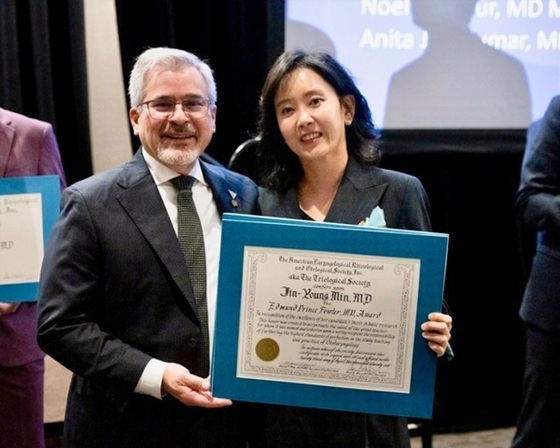
The medical community has recently intensified efforts to fundamentally block the mechanisms underlying difficult-to-treat chronic rhinosinusitis and dramatically reduce patients’ financial and physical burden. At the center of those efforts is Min Jin-young, a professor of otolaryngology at Kyung Hee University Hospital who received the Edmund Prince Fowler Award from The Triological Society, one of the most prestigious and longest-standing organizations in the U.S. otolaryngology field.
Established in 1971, the award is presented each year to just one outstanding basic research paper in otolaryngology submitted from around the world. Min is only the second South Korean medical professional to receive the award and the first Korean recipient in the rhinology field.
Min’s paper, titled “Nongastric Hydrogen-Potassium Pump in Type 2 Inflammation-Related Airway Acidification: Association With Chronic Rhinosinusitis With Nasal Polyps,” was highly recognized for identifying a new disease mechanism for chronic rhinosinusitis and laying the groundwork for practical, personalized treatment strategies.
A Chance Clue From a Gastroenterology Lecture Leads to a Top Global Research Award
His intense focus on research was driven by the deep despair he witnessed among patients with difficult-to-treat disease.
Even after sinus surgery is completed successfully, inflammation and nasal polyps often recur continuously because of the immune mechanisms of the mucous membranes themselves. To suppress this recurrent inflammation, biologic drugs such as Dupixent, which selectively block specific inflammatory factors, have recently entered clinical practice.
The problem is the prohibitively high barrier to access. While these drugs can produce dramatic effects by selectively blocking immune cells that drive Type 2 inflammation, limited health insurance coverage means they can cost more than $1,000 a month, while also requiring patients to visit hospitals every two weeks for injections.
Min’s research began with a strong desire to narrow the gap for patients who give up treatment because of the cost of these expensive drugs and the burden of frequent hospital visits. The starting point for his breakthrough idea was, unexpectedly, a gastroenterology lecture he attended while studying in the U.S.
“During my training in the U.S., I suddenly remembered a gastroenterologist explaining acid reflux and saying that stomach acid is not simply a problem of ‘acid’ but is also connected to immune and inflammatory responses in the nose and asthma,” Min recalled. “That memory made me wonder whether the hydrogen-potassium pump (H,K-ATPase) protein molecules found in the digestive system might also exist in the nose, so I started researching it out of curiosity.”
Basic experiments that began as a curiosity ultimately revealed the presence of a nongastric hydrogen-potassium pump in the nasal mucosa and showed that the pump acidifies the airways and worsens inflammation. The finding identified a new therapeutic target: an “acidification pump” within the nasal mucosa.
Min noted that drugs that block the action of this pump are already used in gastroenterology, including as stomach-protective medications. Based on this finding, he laid the groundwork for an original “cocktail treatment strategy” combining existing safe and inexpensive drugs. In outpatient care, when medication is required, he has also begun connecting his basic research to clinical practice by prescribing stomach-protective drugs that target the pump in combination with other treatments.
“Making Sure Patients Don’t Give Up Treatment Because of Drug Costs”: A Personalized “Cocktail Therapy” Focused on Patients’ Finances
Building on this foundation, Min’s “personalized cocktail drug therapy” is not a concept that relies on a single, high-profile new drug. Like a cocktail that combines multiple ingredients to create the best flavor, the strategy involves combining existing safe and affordable drugs with different mechanisms of action according to each patient’s condition.
The idea is to move away from a model that relies entirely on biologic drugs costing more than $1,000 a month and instead use existing drugs together as adjuvant therapy to dramatically reduce patients’ financial and physical burden.
“It is realistically difficult to cure a difficult-to-treat disease once and for all with a single drug,” Min emphasized. “For patients to take a medication repeatedly over the long term, it must not cause side effects and must not impose a financial burden. That is what will improve adherence and make continuous management possible.”
In fact, what motivates him most to continue his research in the clinic is seeing patients regain the “small things in everyday life.”
“I remember a patient in his 50s who had been unable to smell for more than 30 years. After treatment, he came back and told me he was so happy to be able to smell the aroma of wine again,” Min said. “Sinusitis is not a severe disease that immediately threatens life, but it can destroy the everyday activities of breathing and smelling and drive quality of life to the bottom.”
In fact, research infrastructure in otolaryngology, particularly in rhinosinusitis, is less developed than in more severe diseases, and inexpensive drug-combination strategies also face difficulty in attracting commercial clinical investment from pharmaceutical companies. Nevertheless, Min continues to meet regularly with fellow researchers who share his goals, exchanging ideas and dedicating themselves to research.
“The fact is that these high-cost biologics are excellent drugs. I have no intention of competing with them or beating them. They are genuinely very good drugs,” Min said with a smile.
“However, what I dream of is completing an adjuvant treatment that can extend the intervals between injections so patients don’t have to receive these excellent injections at such high cost every time, while reducing their financial and physical burden,” he continued. “Rather than developing a blockbuster new drug, helping patients breathe comfortably without financial strain and regain the small joys of everyday life is the path I, as a doctor and researcher, must pursue to the end.”