

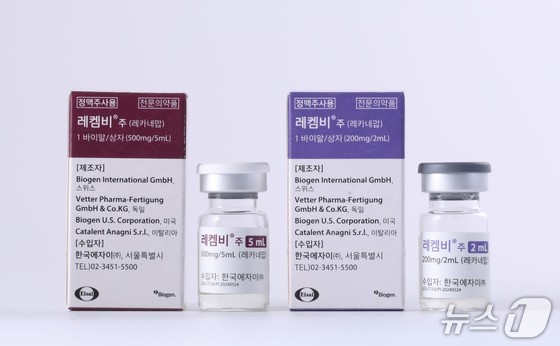
A real-world study of Korean patients receiving lecanemab (Leqembi), an Alzheimer’s disease treatment designed to slow disease progression, found that major adverse events were generally mild or asymptomatic and could be managed with appropriate monitoring.
The research team, led by Professor Kang Sung-hoon of the Department of Neurology at Korea University Guro Hospital, analyzed the clinical experience of Korean patients treated with lecanemab. The findings were recently published in the Alzheimer’s Association’s international journal Alzheimer’s & Dementia: Diagnosis, Assessment & Disease Monitoring.
Although the efficacy and safety of lecanemab have been established through international clinical trials, real-world data involving Asian patients have remained limited. The researchers therefore analyzed 127 Korean patients who began lecanemab treatment between December 2024 and October 2025, focusing on infusion-related reactions and amyloid-related imaging abnormalities (ARIA).
Infusion-related reactions—including fever, generalized weakness and headache—occurred in 21.3% of patients, with most occurring during or shortly after the first infusion.
Among the 102 patients who underwent follow-up MRI scans, ARIA was detected in 8.8%. Most cases were mild or did not produce clinical symptoms.
Mini-Mental State Examination (MMSE) scores remained relatively stable through six months after treatment initiation. However, patients with a greater number of pre-existing cerebral microbleeds or more severe white-matter changes showed a higher risk of developing ARIA, highlighting the importance of risk assessment before treatment and regular MRI monitoring.
The researchers subsequently expanded the analysis to 233 patients. In the expanded cohort, infusion-related reactions occurred in 25.3%, while ARIA-E, which involves brain edema or effusion, occurred in 4.0% and ARIA-H, associated with cerebral microbleeds and related hemorrhagic findings, occurred in 8.5%. The overall pattern was similar to that of the initial analysis, with no new safety signals identified after expansion. Most adverse events remained mild or asymptomatic.
Professor Kang said the study was significant because it analyzed lecanemab’s treatment course and safety in an actual Korean clinical setting. He emphasized that most infusion reactions and ARIA cases were manageable and that evaluating risk with MRI before treatment and conducting regular monitoring could support safer treatment.

Lecanemab has attracted attention because it represents a shift from conventional Alzheimer’s treatments that primarily target symptoms such as memory and cognitive decline. Lecanemab targets amyloid-beta pathology and has been shown in clinical trials to slow the progression of early Alzheimer’s disease, although treatment requires ongoing safety monitoring because of risks including ARIA.
The study also involved neurology resident Shin Jae-min, Professor Seo Sang-il of Radiology, and Professor Eo Jae-sun of Nuclear Medicine. The research was based on a standardized longitudinal cohort that tracks patients’ clinical outcomes, blood biomarkers, MRI findings, amyloid PET scans and cognitive changes.