

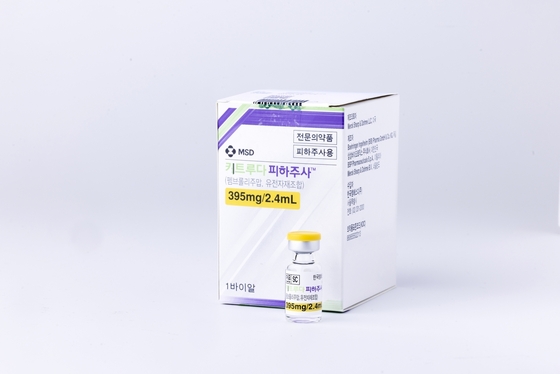
The subcutaneous (SC) formulation of the global blockbuster immunotherapy drug Keytruda has officially hit the South Korean market. Following its overseas launch, quarterly sales have skyrocketed nearly fourfold in just three months, sparking interest in whether Korean patients will make the switch from the existing intravenous (IV) administration to the SC version.
Industry insiders report that as of yesterday, MSD Korea began distributing Keytruda SC (active ingredient pembrolizumab) domestically. This comes roughly four months after receiving approval from the Ministry of Food and Drug Safety last May.
Keytruda SC combines the existing Keytruda with verahyaluronidase alpha, enabling subcutaneous delivery of a higher volume of antibody medication. It’s approved for 35 indications across 18 cancer types, including lung cancer, triple-negative breast cancer, gastric cancer, and endometrial cancer – mirroring the existing IV formulation’s scope.
The game-changer here is the administration time. While the IV formulation requires about 30 minutes per dose, the SC version can be administered in just one minute when given in the thigh or abdomen every three weeks, or two minutes for a six-week interval. Patients can also switch between IV and SC formulations as needed.
The burning question is whether Korean patients will rapidly transition from IV to SC. Early indicators suggest strong momentum, with Keytruda SC sales surging since its launch.
The FDA greenlit Keytruda SC under the brand name ‘Keytruda Qurex’ in September last year. MSD reports that Keytruda Qurex’s global sales leapt from 5 million USD in Q3 2025 to 35 million USD in Q4, with annual sales hitting 40 million USD.
The upward trajectory continued into 2026, with Q1 sales of 128 million USD ballooning to 463 million USD in Q2 – a staggering 3.6-fold increase in just one quarter. The first half of 2026 alone saw sales of 590 million USD.
As SC sales climb, so does its slice of the overall Keytruda revenue pie. Q2 2026 saw the IV Keytruda rack up 7.904 billion USD in sales, while Keytruda Qurex contributed 463 million USD. Of the combined 8.366 billion USD in sales, SC now accounts for approximately 5.5%.
MSD cites Keytruda Qurex’s successful market entry as a key driver of Keytruda’s growth. Their Q2 earnings report highlighted combined Keytruda and Keytruda Qurex sales of 8.4 billion USD, a 5% year-over-year increase, partially crediting Keytruda Qurex’s market debut for this growth.
The dramatically reduced administration time is expected to sway patients’ formulation choices. A phase 2 crossover study of patients who’ve experienced both SC and IV found 65% preferred the SC version. With the option to switch between IV and SC now available in Korea, current Keytruda patients’ preferences will likely shape the SC market’s expansion.
However, it remains to be seen if the SC growth trend observed globally will maintain its pace in the Korean market. Actual uptake will hinge on various factors beyond patient and healthcare provider preferences, including insurance coverage criteria for different cancer types and treatment stages, as well as healthcare facility infrastructures.