Dong-A Socio Holdings has brought its core operating company, Dong-A Pharmaceutical, back into the group’s holding company. The move comes 13 years after the group separated its holding and operating companies as part of its transition to a holding company structure in 2013. Dong-A Socio Holdings, previously a pure holding company, has now become an operating holding company that directly runs consumer-facing businesses such as Dong-A Pharmaceutical’s Bacchus and over-the-counter medicines, internalizing the group’s cash-generating capabilities within the parent company.
According to industry sources on the 7th, Dong-A Socio Holdings recently completed the absorption merger of its wholly owned subsidiary Dong-A Pharmaceutical. The surviving entity is the existing Dong-A Socio Holdings, while Dong-A Pharmaceutical was dissolved. However, following the merger, the surviving entity changed its name to Dong-A Pharmaceutical, bringing the group’s flagship operating brand back as the name of the integrated company.
Because Dong-A Socio Holdings already owned 100% of Dong-A Pharmaceutical, the merger was carried out as a small-scale merger without issuing new shares. As a result, there was no change in existing shareholders’ ownership percentages or the number of shares outstanding. Following the merger, the number of subsidiaries under Dong-A Socio Holdings decreased from 10 to nine.
Dong-A’s corporate governance structure underwent a major change in 2013. At the time, Dong-A Pharmaceutical was split into a holding company and an operating company, creating a structure in which Dong-A Socio Holdings managed the overall group while Dong-A Pharmaceutical handled consumer-facing businesses. The group’s current structure was subsequently established, with major affiliates such as Dong-A ST taking responsibility for specialized businesses.
Bringing Back Core Businesses Separated After the 2013 Holding Company Conversion
This time, the group has moved in the opposite direction. Rather than keeping Dong-A Pharmaceutical as a core subsidiary, the holding company has internalized the business directly. While the group separated its business and holding company functions 13 years ago, it has now brought them back together, a move interpreted as an effort to improve management efficiency and accelerate investment decisions.
Another notable aspect is that the integrated company can now directly secure Dong-A Pharmaceutical’s stable cash-generating capacity.
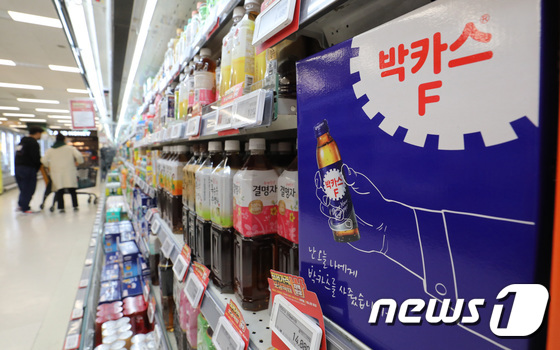
Dong-A Pharmaceutical sells Bacchus, Panpyrin and other over-the-counter medicines, as well as health functional foods and daily health products, and has served as one of the group’s major sources of revenue. In the first half of this year, it posted revenue of $277.5 million and operating profit of $33.9 million.
With Dong-A Pharmaceutical’s business performance now directly reflected in the integrated company, the way investment resources are utilized could also change going forward.
Under the previous pure holding company structure, the holding company primarily held stakes in subsidiaries and secured cash through dividends and other means. As an operating holding company, however, it can now directly use operating cash flow generated by its own businesses for new businesses and investments.

The Dong-A Socio Group operates a range of businesses beyond pharmaceuticals, including logistics and contract manufacturing of biopharmaceuticals. Consolidated revenue in the second quarter of this year rose 18.9% year over year to $274.9 million, while operating profit increased 38.3% to $26 million. Growth at Dong-A Pharmaceutical and Yongma Logis drove the group’s overall performance.
Changes are also expected from a corporate valuation perspective. Dong-A Pharmaceutical previously existed as an unlisted subsidiary, leading to criticism that its business value was not fully reflected in the holding company’s valuation. By bringing Dong-A Pharmaceutical’s operations directly into the integrated company, the group can reduce the so-called “holding company discount” and more directly reflect business performance in its corporate value.
Global Expansion and New Business Investment to Determine Success Beyond Bacchus
The merger also presents challenges. Following the integration, how and how efficiently the company invests the cash and business foundation it has secured will become increasingly important.
Dong-A Pharmaceutical is expanding its consumer healthcare business, including over-the-counter medicines and health functional foods, based on its strong Bacchus brand. Securing new growth engines beyond Bacchus is considered a key challenge.
Expanding its global business is another major task. Having secured stable cash-generating capacity in South Korea, the company needs to channel those resources into overseas expansion and investment in new businesses to demonstrate the benefits of the corporate governance restructuring.
“The success of the merger will depend less on the organizational change of ‘becoming one again’ than on whether the business foundation secured through the integration can actually be converted into growth,” an industry source said. “The key question is whether Dong-A can create new growth engines in global and new businesses while leveraging the stability of traditional consumer businesses such as Bacchus.”