The Korean equivalent of ARPA-H is launching initiatives to develop a vaccine that provides long-lasting immunity with a single dose and treatment technologies to eliminate dormant pathogens in the body. Four research teams from Chonnam National University, Korea University, Institut Pasteur Korea, and Sungkyunkwan University are vying to secure next-generation infectious disease response technologies through competitive research.
The K-Health Future (Mirae) Promotion Team announced on Tuesday that this year’s new projects include ENDUREx, a long-term immunity vaccine platform development program, and ERASEx, a latent infection prevention treatment platform development program. Two research teams will participate in each project to validate the feasibility of these technologies over the next 30 months.
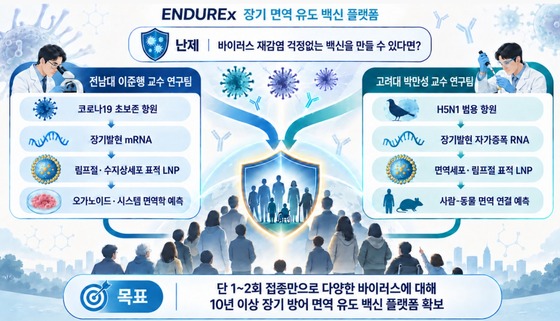
ENDUREx aims to develop a vaccine that maintains long-term immunity while addressing viral mutations, such as those seen in COVID-19 and influenza.
Professor Lee Jun-hyung’s team from Chonnam National University plans to select antigens with fewer mutations and combine messenger RNA (mRNA) with delivery technology to combat COVID-19 variant viruses. Professor Park Man-seong’s team from Korea University is developing a vaccine platform that broadly targets various influenza viruses, including avian influenza.
Both research teams are aiming for technology that can maintain protective immunity against three or more variants for over a decade with just one or two initial vaccinations. However, this is a research and development goal, not a current achievement. They plan to predict long-term immunity sustainability using animal experiments, human simulation models, and immune cell markers, while gathering evidence needed for clinical trials.
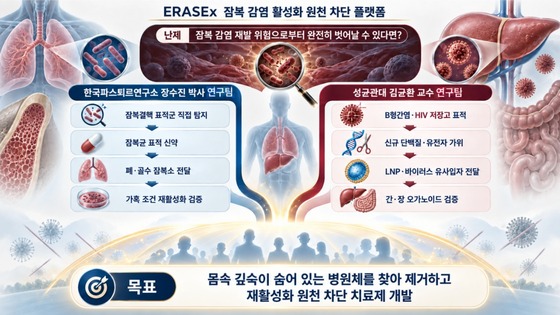
ERASEx focuses on developing treatment technologies to detect latent pathogens early or eliminate remaining pathogens in the body to prevent reactivation.
Institut Pasteur Korea and Sungkyunkwan University are tackling the challenge of developing technologies to combat latent tuberculosis, hepatitis B, and Human Immunodeficiency Virus (HIV).
Dr. Jang Soo-jin’s team at Institut Pasteur Korea is developing highly sensitive diagnostic technologies to detect latent tuberculosis bacteria and related substances, as well as candidate treatments that directly eliminate latent bacteria. They are also researching drug delivery technologies to reach tissues where latent pathogens may persist, such as the lungs and bone marrow.
Professor Kim Kyun-hwan’s team at Sungkyunkwan University is targeting the genetic reservoirs left by hepatitis B virus and HIV in the body. They plan to develop proteins that eliminate hepatitis B virus genetic material and gene-editing technologies to inactivate HIV genes, and will verify methods to deliver these to infected cells.
The two research teams have distinctly different approaches. While Institut Pasteur Korea is establishing a comprehensive pipeline connecting early diagnosis, targeted treatment, and deep tissue delivery, Sungkyunkwan University is focusing on genetically eliminating the genetic reservoirs left by chronic viruses.
If either strategy proves successful, it could lead to groundbreaking treatments that permanently block the source of recurrence, moving away from the current paradigm of managing relapse fears through lifelong medication.
The promotion team plans to pit different research paths against each other in each project and allocate follow-up resources to the most promising technologies through phased evaluations.
The Korean version of ARPA-H has expanded its research scope this year to include long-term immunity and latent infection, following its work on long-term vaccine storage and mobile production technology in 2024 and the development of treatments to prevent severe early-stage infections in 2025.
Lee Jae-wook, the health security program manager, stated that this initiative marks a shift from reactively securing vaccines and treatments after disease outbreaks to proactively preparing long-term defense technologies. He added that however, both long-term immunity vaccines and latent pathogen elimination are cutting-edge research areas without established solutions. Further validation will be necessary to prove their actual preventive and therapeutic effects.
Meanwhile, experts argue that mission-driven research and development projects like the Korean ARPA-H require rigorous evaluations and stable research environments, given the challenges of achieving results in a short timeframe.
While projects failing to meet phased goals should be decisively terminated, it’s crucial to ensure continuity in budget and support for projects showing technical promise, allowing them to proceed to further validation.
The development of vaccines and treatments involves several interconnected stages, from candidate substance discovery to preclinical trials and clinical entry. Interrupting research midway makes it difficult to fully capitalize on accumulated technologies and infrastructure.
For research and development investments in national health security to yield tangible outcomes, experts believe it’s crucial to establish a system that assesses ongoing support based on technological progress and future potential, rather than simply adjusting budgets.
An industry insider remarked that the proactive investment in research and development (R&D) during calm periods is incredibly cost-effective compared to the astronomical social and economic costs of responding to an infectious disease crisis. They emphasized the pressing need for unwavering budget support and strategic trust from the government and Congress to back researchers’ bold initiatives.