

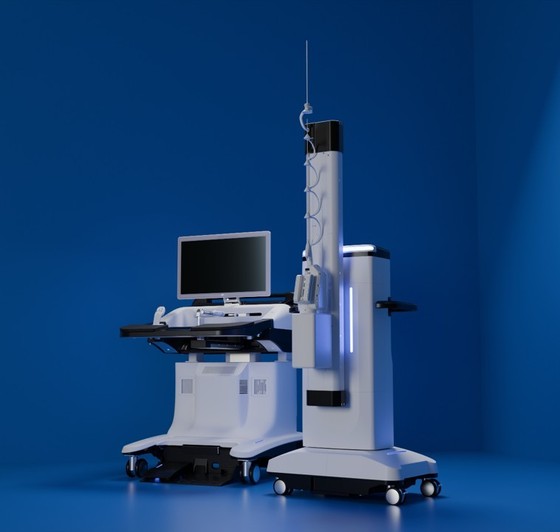
A case in which Zamenix, a kidney stone surgery robot developed by South Korean surgical robotics company Roen Surgical, was used to completely remove a kidney stone that had recurred for 10 years and resisted multiple surgeries has been published in an international medical journal.
Roen Surgical announced on the 19th that a case involving the treatment of a difficult-to-treat kidney stone using Zamenix in Indonesia had been published in the International Journal of Surgery Case Reports (IJSCr), an international peer-reviewed journal.
The study was conducted jointly by a team led by Professor Ponco Birowo at Cipto Mangunkusumo Hospital, affiliated with the University of Indonesia, and a team led by Professor Cho Sung-yong of the Department of Urology at Seoul National University Hospital. It examined a case in which robot-assisted retrograde intrarenal surgery (RIRS) was performed on a patient in Indonesia.
The patient was a 55-year-old woman whose kidney stones had recurred over a 10-year period. Despite undergoing multiple treatments, including extracorporeal shock wave lithotripsy, ureteroscopy and percutaneous nephrolithotomy, doctors were unable to remove a 7-by-8-millimeter stone in the upper calyx of her left kidney. Repeated surgeries had altered the internal anatomy of the kidney, making it difficult to reach the stone using conventional methods.
The research team used Zamenix to remove the stone completely in about 75 minutes. Blood loss during surgery was approximately 3 milliliters, and the patient was discharged two days after the procedure without complications.
The paper also examined Zamenix’s respiratory motion compensation and autonomous navigation functions. The system compensates for kidney movement caused by breathing to support precise surgical instrument control. Its autonomous navigation capability may also reduce the surgical burden on medical staff when operating within the complex internal structure of the kidney.
Co-author Professor Cho is a urologist who has performed more than 4,000 stone removal procedures. The researchers said the case suggests robot-assisted surgery could offer an alternative for treating difficult residual kidney stones in patients whose anatomy has been altered by repeated procedures.
However, the study is a case report describing the outcome of an individual patient. Further research involving a wider range of patients is needed to establish the procedure’s safety and effectiveness.
Roen Surgical plans to build a larger body of clinical evidence for Zamenix and expand academic collaboration with medical professionals overseas following the publication.
Zamenix is an artificial intelligence (AI)-based kidney stone surgery robot equipped with functions including compensation for kidney movement caused by a patient’s breathing and autonomous navigation. According to the company, the system has received U.S. Food and Drug Administration (FDA) 510(k) clearance and has been adopted by 23 hospitals in South Korea and one institution overseas.
“This paper is significant because it adds an internationally published clinical case demonstrating Zamenix’s application in complex stone disease and expands academic collaboration between Korean and overseas medical professionals,” said Kwon Dong-soo, CEO of Roen Surgical.
The company is also pursuing expansion into remote surgery. In June, Roen Surgical signed a memorandum of understanding with Sovato, a U.S. remote surgery platform company, to integrate Zamenix with its remote surgery platform. The two companies plan to proceed in stages with technical reviews and platform integration.