

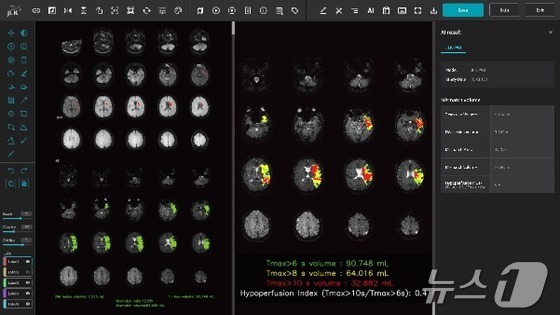
Medical AI company JLK has secured a patent related to a large language model (LLM) that integrates and analyzes medical images and clinical information. The company plans to expand its platform business by combining its existing stroke imaging analysis technology with AI specialized for health care.
JLK announced on the 19th that it had registered a patent titled “LLM-Based Clinical Operations Method and System for Integrating Medical Imaging and Clinical Text Data.”
The patented technology integrates and analyzes medical images, including computed tomography (CT) scans and magnetic resonance imaging (MRI), with clinical information such as electronic medical records (EMRs), test results and radiology reports. It is designed to help AI understand different types of medical data together and apply that information in actual clinical workflows.
The core technology reduces the volume of data AI must process while preserving information needed for medical image analysis. Directly feeding three-dimensional medical images into an LLM can sharply increase the amount of information to be processed, raising computational demands and operating costs. JLK’s patent covers a method for reducing input data by structuring clinically meaningful features, such as lesion location and volume and information about blood vessel occlusion.
The technology also incorporates a mechanism to improve the reliability of AI-generated responses. Known as “grounding,” the approach limits the scope of responses based on quantitative analysis results and medical guidelines. The goal is to encourage answers grounded in medical evidence and reduce the risk of errors in clinical settings.
The technology has been incorporated into JOOMED, JLK’s multimodal LLM platform specialized in medical imaging. JOOMED is designed to integrate and analyze medical images alongside EMRs, patient information and test results.
JLK said it validated JOOMED’s operating environment with Intel, a global semiconductor company, in July. According to the company, the platform produced identical analytical results in environments powered by Intel Arc Pro B70 and Nvidia A100 hardware.
In the market for medical-specialized LLMs, technologies that go beyond retrieving medical knowledge to comprehensively analyze medical images, patient histories and test results are becoming increasingly important. However, practical clinical deployment still requires ensuring the accuracy and safety of AI responses and integrating the technology with hospital systems and clinical workflows.
JLK plans to strengthen JOOMED’s intellectual property portfolio through the patent and expand its medical AI platform business.
“Using AI in clinical settings requires specialized technology that can understand medical images and clinical information together and connect with hospital systems,” said Lee Myung-jae, vice president of JLK. “We will combine our existing medical imaging AI technology for stroke with multimodal LLMs to expand our business into next-generation medical AI platforms.”
Meanwhile, JLK currently supplies AI-based stroke solutions to major university hospitals in South Korea and is expanding overseas based on regulatory clearances from the U.S. Food and Drug Administration (FDA) and Japan’s Pharmaceuticals and Medical Devices Agency (PMDA).
The company aims to establish trusted AI standards for medical professionals based on the extensive clinical evidence accumulated in real-world medical settings. It also seeks to create a virtuous cycle linking new medical technology assessments, broader adoption by health care institutions and expansion into global markets.