Curiosis, a South Korean company specializing in laboratory automation, unveiled its artificial intelligence (AI)-powered self-driving laboratory technology at the 2026 World Bio Summit, seeking to expand collaboration with global pharmaceutical and biotechnology companies.
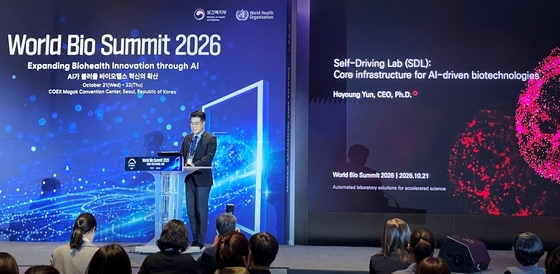
Curiosis said on the 22nd that it participated as an official speaker in a main session of the 2026 World Bio Summit, which opened on the 21st, presenting its vision for the technological development of self-driving labs (SDLs) and strategies for global standardization.
The World Bio Summit is an international event co-hosted by the South Korean government and the World Health Organization (WHO). This year’s summit focused on “Expanding the Reach of Biohealth Innovation Through AI” and brought together representatives from global pharmaceutical companies and international organizations.
Yoon Ho-young, CEO of Curiosis, delivered a presentation on self-driving labs during a session titled “The Future AI Will Bring.” Yoon explained that AI has advanced to the point where it can formulate research hypotheses, but experiments to validate those hypotheses using actual biological data still rely heavily on human labor.
Self-driving labs automate the research process, from experimental design and execution to data analysis and decisions about subsequent experiments. By combining AI with robotics, the technology can reduce the labor required for repetitive experiments and minimize human error during research.
At the summit, Curiosis presented an unmanned automated workflow built around its proprietary CurioSystem technology. The solution combines Celloger, a live-cell imaging system capable of long-term cell observation, with CPX, an automated colony picker.
The company also unveiled self-driving lab models designed specifically for large-scale organoid cultivation and high-throughput screening (HTS).
During the event, Curiosis also held partnership meetings with global pharmaceutical companies and overseas research institutions to discuss supplying automation solutions and pursuing joint collaboration opportunities.
“However advanced AI becomes, bioinnovation cannot be completed without physical data infrastructure,” Yoon said. “Building on our proprietary laboratory automation technology, we will lead the way toward fully unmanned, autonomous workflows for global pharmaceutical and biotechnology research.”