Hyundai Motor Group has, for the first time, opened up its accumulated experience in artificial intelligence transformation (AX) to South Korea’s industrial sector. By sharing not only success stories but also setbacks and lessons learned, the group aims to accelerate AI adoption across the industry.
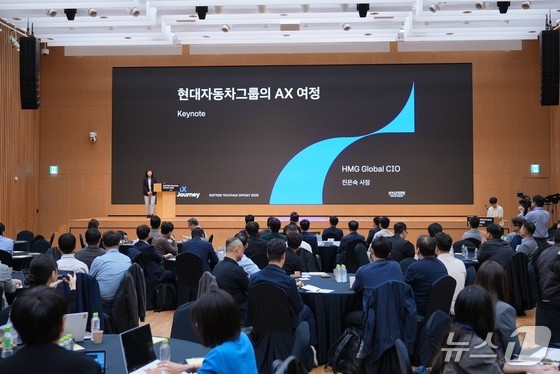
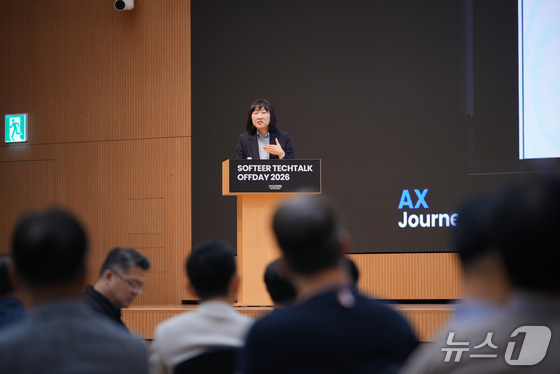
Hyundai Motor Group said on the 22nd that it held its technology conference, “Softier Tech Talk Off Day 2026,” on the 21st at its headquarters in Yangjae, Seocho District, Seoul, for IT leaders from South Korean companies and members of the media.
Softier Tech Talk is an internal technology event where Hyundai Motor Group IT employees share the results and lessons from projects they have worked on throughout the year. Held annually since 2023, the event reached its fourth edition this year and was opened to external participants for the first time.
The event covered not only successful AI implementations but also setbacks encountered during development, how those challenges were addressed and the issues that remain unresolved. The goal is to help South Korean companies pursuing AX apply the group’s experience to their own operations.
Jin Eun-sook, president overseeing ICT at Hyundai Motor and Kia, said, “AX is not something that can be completed by introducing a single technology. It is a continuous process of searching for answers. The challenges Hyundai Motor Group has faced are similar to those confronting any company pursuing AX, so we will share our experiences, listen to others’ perspectives and work together to find solutions.”
“70% of Employees Use the Group’s Internal Generative AI”
Hyundai Motor Group explained how it built the foundations for AI adoption, including its digital transformation (DX) initiatives and data management systems.
Even before the AI era fully took hold, the group had been pursuing DX focused on modernizing work practices and data systems. It introduced work management and knowledge-sharing platforms, along with cloud-based collaboration environments, to consolidate information and work records that had previously been scattered across individual organizations.
The group also centralized responsibility for managing data and IT systems and established mechanisms to connect and use data across departments.
These efforts have enabled the group to collect real-time data from approximately 12 million connected cars worldwide and accumulate about 140 petabytes of vehicle sensor data. Operational data covering customers, quality and sales across dozens of corporate entities is also managed through more than 7,000 data pipelines.
The group has also expanded access to generative AI. In 2023, it introduced H Chat, an internal generative AI platform. More than 70% of group employees now use it in their work.
The group also established security standards that allow cloud services to be used, in accordance with government policy, in nationally designated core technology fields subject to strict restrictions on overseas data transfers, including autonomous driving and hydrogen technologies. Based on these standards, the group expanded H Chat access to nationally designated core technology divisions in July.
“AI Models Consolidated and Deployed Across 73 Production Processes Worldwide”
Hyundai Motor Group also shared examples and results of applying AI to actual business operations, including demand forecasting, vehicle maintenance and manufacturing.
To address the problem of AI systems succeeding in pilot programs but failing to become established in day-to-day operations, the group focused on three priorities: building common platforms, earning the trust of frontline employees and establishing effective data management systems.
First, it developed a shared platform incorporating internal search, chatbot and AI agent functions, while consolidating AI models that had previously operated separately at individual sites. An AI system that recognizes vehicle identification numbers (VINs) to detect errors in vehicle assembly sequences initially relied on separate models at different factories. Those models have since been consolidated into a single system now deployed across 73 production processes in South Korea and overseas.
The group also made it easier for employees to use AI and verify its results themselves. Instead of requiring employees to manually enter vehicle sales demand forecasts, the system now generates initial proposals using AI. An AI tool that assists mechanics with vehicle inspections also provides supporting evidence from official service manuals.
The group improved its data management system as well, consolidating work-related information previously scattered across departments and requiring each department to keep its own data up to date. As a result, the time needed to search for internal information fell from about 10 minutes to approximately 20 seconds through a unified search system.
Park Geun-han, senior vice president of Hyundai Motor and Kia’s Machine Learning Lab, said, “What determined the success or failure of AI initiatives was not the AI technology itself, but clearly defining problems that reflect real-world needs, having a common platform and establishing a sustainable data management system led by the business units themselves. The systems we have built by systematically addressing constraints in the field will become a competitive advantage that others cannot easily replicate.”
“Introducing an Internal Platform for Sharing AI Tools”
The group also discussed additional measures to address the expansion of AI use across its organizations. This month, it plans to launch H-Launch, an internal service deployment platform that will allow employees without software development expertise to share work tools they have created using AI with their colleagues.
The group will also establish a management system that assigns unique IDs to AI agents and records all their activities. To ensure safety, operations that are difficult to reverse, such as deleting data, will require human approval.
For organizations that require large amounts of GPU computing resources, the group will gradually build the capability to provide those resources as a service through a “GPU Service” offering. The initiative is intended to support the development of physical AI, including autonomous driving and robotics.
Starting in the fourth quarter of this year, the group plans to use large-scale GPU resources and its internally developed AI platform to build foundational capabilities, expand capacity and advance automation. Its goal is to begin operating services from the Saemangeum AI Data Center in the second half of 2029, using more than 10,000 GPUs.
Hyundai Motor Group plans to continue sharing its accumulated AX experience and expertise with South Korean companies to support broader AI adoption across industries.
Jin said, “Regardless of what technology emerges, the most important thing is an organizational culture that can quickly put it to use and turn it into business results. We will build an organization that learns quickly, unlearns quickly and learns again, enabling us to stay ahead of the next wave of technological innovation.”
Softier is a combination of the words “software” and “engineer,” referring to pioneers in automotive software. Hyundai Motor Group is working to strengthen its software and AI capabilities through initiatives such as the Softier Programming Festival for employees and the Softier Bootcamp, a training program linked to recruitment.