

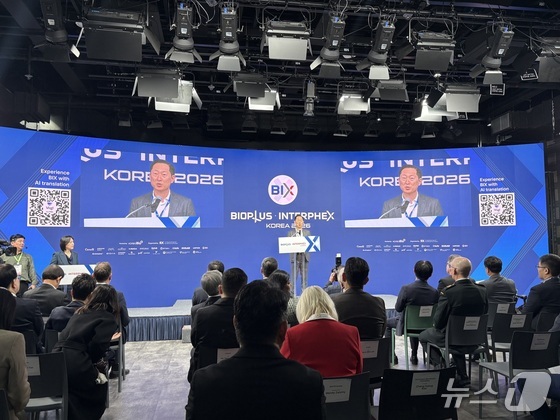
Over the past year, the biotech industry has been feeling somewhat sidelined, according to Koh Han-seung, president of the Korea Bio Association. Speaking at the opening ceremony of BioPlus-Interfex Korea 2026 (BIX 2026) at COEX in Seoul on Wednesday, Koh highlighted that global investments are increasingly funneling into artificial intelligence (AI), making it challenging for biotech firms to secure funding.
BIX, hosted by the Korea Bio Association, is a premier global exhibition and conference for the biotech and pharmaceutical industries. This year’s event, themed, Connecting the Global Bio Value Chain, brings together over 300 companies from 35 countries and more than 10,000 attendees to exchange cutting-edge technologies, industry insights, and explore collaborative opportunities.
Koh noted that these days, he’s cautioning many companies against overplaying the AI card when seeking follow-up investments. If leveraging AI was the strategy for attracting investors, it should have made that move three or four years ago.
He criticized the disconnect between government rhetoric and business realities, stating that while the government claims to have addressed all issues through dialogue, companies on the ground are struggling to operate. It needs a thorough examination of specific challenges and a roadmap for necessary changes to facilitate business operations.
Koh emphasized the evolving landscape, saying that in today’s market, having a unique idea, material, or technology isn’t enough. To identify partners who can help navigate challenges, it needs to invest in building personal relationships.
Lee Min-woo, director of the Industrial Growth Office at the Ministry of Trade, Industry and Energy, pledged increased support for the biotech sector. It’s committed to ongoing dialogue with industry players to develop policies that will catalyze a biotech boom, Lee stated.
The ministry’s plans include promoting AI-driven innovations in biomanufacturing and stabilizing the supply chain for materials, components, and equipment. Specifically, it aims to invest 400 billion KRW (approximately 299 million USD) by 2033 to bolster key biotech materials and components technologies. The initiative also includes enhancing AI capabilities in public contract development and manufacturing (CDMO) facilities and expanding investment attraction efforts.
Canada, this year’s guest country, expressed enthusiasm for expanding biotech collaboration with Korea. Philip Jennings, Deputy Minister of Innovation, Science and Industry of Canada, highlighted significant opportunities for bilateral cooperation in AI-driven biomanufacturing, mRNA technologies, and cell and gene therapies. The Canadian delegation included 25 biotech firms participating in the event.
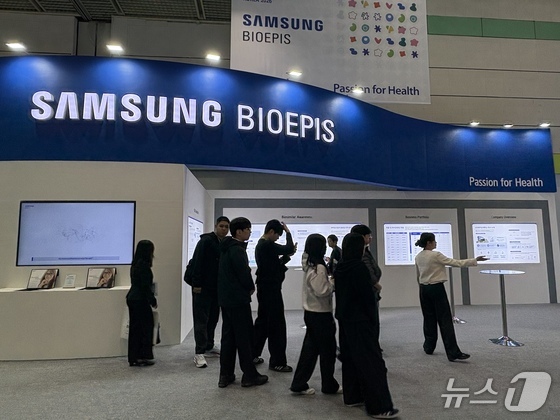
Samsung Biologics and Bioepis Showcase Technological Prowess, Emphasizing Biosimilar Value
The exhibition floor buzzed with activity as leading Korean biotech firms demonstrated their technological capabilities and business acumen. Samsung Biologics, marking its fifth consecutive year at the event since 2022, set up a dedicated booth showcasing its comprehensive biopharmaceutical services spanning contract research (CRO), development (CDO), and manufacturing (CMO).
Lee Tae-hee, head of Samsung Biologics’ Antibody Cell Purification Process Development Team, is scheduled to present on the challenges and strategies in developing bispecific and multispecific antibodies. His talk will highlight the company’s tailored manufacturing and quality management (CMC) capabilities, covering everything from cell line development to analysis for these next-generation therapeutics.
Samsung Bioepis put the spotlight on its portfolio of 11 products currently available in Korea, emphasizing the socioeconomic benefits of biosimilars. Their exhibit featured an interactive program simulating the hand movements of rheumatoid arthritis patients, aiming to deepen understanding of the condition.
The company underscored how biosimilars can expand treatment options for patients while alleviating the strain on healthcare budgets. They advocated for additional policy support to boost biosimilar adoption in Korea, noting that prescription rates lag behind those of other major markets.
Samsung Bioepis also unveiled its pipeline of nine biosimilars and three novel biologics in development. The company shared its research and development (R&D) strategy, which leverages AI to enhance efficiency and promotes open innovation through collaborations with external partners and other Samsung affiliates.