

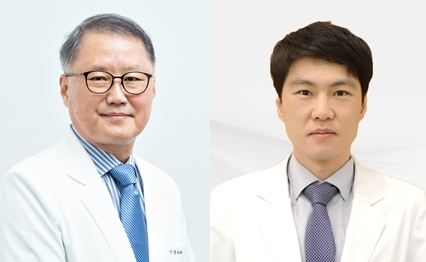
If muscles on one side of the face twitch involuntarily or severe, electric shock-like pain repeatedly strikes, a blood vessel pressing against a cranial nerve may be the cause. A team of professors at Konkuk University Medical Center has performed more than 6,000 microvascular decompression procedures, a surgery used to treat hemifacial spasm and trigeminal neuralgia. The achievement is rare even by global standards.
Konkuk University Medical Center announced on the 2nd that its neurosurgery team, led by professors Park Kwan and Lee Hyun-seok, had performed a cumulative total of 6,015 microvascular decompression procedures as of September. Medical teams worldwide that have performed more than 6,000 of these surgeries are considered rare.
Microvascular decompression involves separating a blood vessel that is compressing a cranial nerve, eliminating the source of pain or muscle spasms. It is a leading surgical treatment for hemifacial spasm, in which muscles on one side of the face repeatedly twitch, and trigeminal neuralgia, which causes intense pain resembling electric shocks or stabbing sensations in the face.
By condition, 5,447 procedures were performed for hemifacial spasm, accounting for approximately 90.6% of the total. Another 563 procedures treated trigeminal neuralgia, while five were performed for other conditions, including glossopharyngeal neuralgia. Hemifacial spasm causes repeated contractions of muscles on one side of the face. The spasms may begin around the eye and spread to the area around the mouth.
Accurate diagnosis is important to distinguish hemifacial spasm and trigeminal neuralgia from similar conditions. Doctors assess symptoms and how long they have persisted, and use tests such as magnetic resonance imaging (MRI) to examine the relationship between nerves and blood vessels. Whether to proceed with surgery is determined by considering the severity of symptoms and the patient’s response to previous treatments.
The average age of patients undergoing surgery for hemifacial spasm was 52. Women accounted for 4,236 patients, or 77.8%, more than three times the 1,211 men, or 22.2%. For trigeminal neuralgia, the average surgical age was 57. Women made up 380 patients, or 67.5%, compared with 183 men, or 32.5%.
The team has focused not only on increasing its surgical volume but also on improving safety and precision. Because microvascular decompression requires operating on extremely small blood vessels and nerves around the brainstem and cranial nerves, accurately locating the point of compression while minimizing damage to surrounding nerves is essential.
To achieve this, the team has advanced neurophysiological monitoring techniques that allow surgeons to monitor electromyography and brainstem auditory evoked potentials in real time during surgery. It has also continued research aimed at preserving hearing and preventing postoperative complications. In addition, the team has studied the anatomical relationships between nerves and blood vessels and methods for precisely identifying the points where nerves are compressed.
The team’s experience has also led to international academic contributions. Its research has been published in major domestic and international journals, including the Journal of Neurosurgery, World Neurosurgery, Acta Neurochirurgica and Scientific Reports.
The team has also published three specialized medical books through Springer, an international academic publisher. Since 2020, the books have systematically covered the diagnosis and treatment of hemifacial spasm, intraoperative nerve-monitoring techniques, and diagnostic and surgical strategies for trigeminal neuralgia.
Professors Park Kwan and Lee Hyun-seok said, “Building on our accumulated surgical experience, we will continue to advance our surgical techniques and neurophysiological monitoring technology. We will also pursue clinical and academic research to improve patient safety and treatment outcomes, while working to train the next generation of specialists.”