

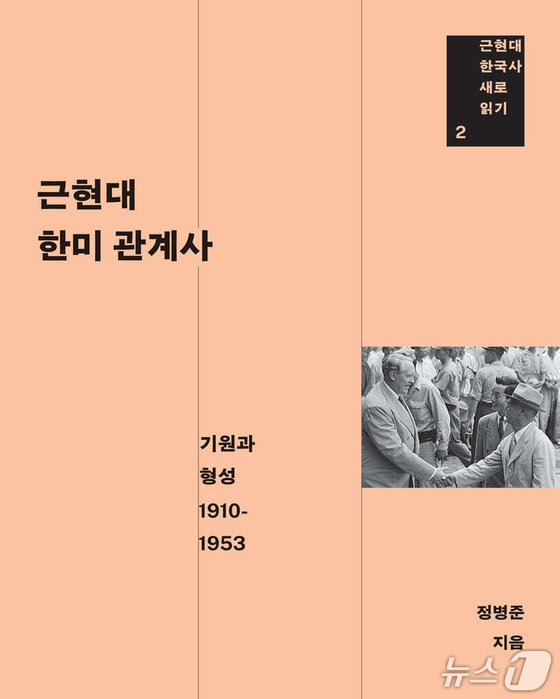
The book “Modern and Contemporary History of Korea-U.S. Relations” examines the evolution of U.S. policy toward Korea from 1910, when the U.S. recognized Japan’s forced annexation of Korea, to 1953, when the Korea-U.S. Mutual Defense Treaty was established. As the second volume in Social Critique’s “Reinterpreting Modern Korean History” series, it analyzes the interplay between Korea’s diplomatic expectations and U.S. international interests through key historical events.
Contrary to the common view of the Korea-U.S. alliance as a starting point, the book argues that the relationship developed through phases of indifference, intervention, and alliance. After acknowledging the Eulsa Treaty in 1905 and the forced annexation in 1910, the U.S. treated Korean issues as Japan’s internal matters. Meanwhile, Korea relied on the mediation clause of the Korea-U.S. Treaty of Amity and Commerce and hoped for American goodwill. From the outset, the expectations and policies of both nations were misaligned.
The first chapter covers the post-Russo-Japanese War period, when President Theodore Roosevelt’s administration viewed Japan as a stabilizing force in East Asia and accepted its control over Korea. The U.S. withdrawal from Seoul and approval of the annexation were influenced by Pacific strategies and international political interests. At the time, U.S. interests in Korea centered on economic benefits, such as the Unsan Gold Mine, along with missionary privileges and rights for Christian institutions.
Chapter two explores the March 1 Movement of 1919, the Paris Peace Conference, and the Washington Conference (1921-1922). Independence activists like Ye Woon-hyung, Kim Kyu-sik, and Syngman Rhee, along with the Korean-American community, sought to legitimize Korea’s independence and gain U.S. support. President Woodrow Wilson’s principle of self-determination inspired these activists to believe that shifting international dynamics could create opportunities for independence.
However, the Korean issue highlighted by the March 1 Movement diverged from official U.S. government policies. While American missionaries, religious groups, media, and some political figures showed humanitarian concern for the peaceful independence movement and Japanese repression, the U.S. government maintained that Korea was an internal Japanese matter. It refrained from officially supporting independence or intervening despite potential diplomatic conflicts with Japan. The book characterizes this as a duality of humanitarian concern and diplomatic indifference.
The Pacific War in 1941 marked a turning point. As the U.S. engaged Japan in conflict, it began to view Korea as a territory that should be separated from Japan and granted independence. The 1943 Cairo Declaration included plans for Korean independence and international trusteeship. The independence movement’s diplomatic efforts, which demanded recognition of the Korean Provisional Government and immediate independence, aligned with this shift. The author describes this policy change as the end of indifference.
The post-liberation period saw the division at the 38th parallel, U.S. military governance, the Moscow Conference, and the establishment of the Republic of Korea alongside the withdrawal of U.S. troops. After Japan’s 1945 defeat, Korea was divided along the 38th parallel between U.S. and Soviet occupation. The U.S. military government in the south implemented occupation policies without adequate preparation, revealing discrepancies between local military governance’s nationalist approach and the State Department’s international cooperative stance.
Following the U.S.-Soviet Joint Commission’s failure, the U.S. referred the Korean issue to the United Nations (UN), leading to the Republic of Korea’s establishment in 1948. However, the U.S. completed its troop withdrawal in 1949 without providing a separate security commitment or alliance treaty. The book also highlights how pre-existing relationships through American religious and educational institutions combined with post-liberation U.S. military governance to foster pro-American political and social forces.
The final chapter analyzes North Korea’s 1950 invasion, U.S. and UN involvement, the northward advance beyond the 38th parallel, China’s intervention, and the path to the Korea-U.S. Mutual Defense Treaty. The conflict expanded from a civil war to an international confrontation involving the U.S., UN, and China. The Incheon Landing Operation sparked U.S.-South Korean disagreements over northern territory control, while Chinese intervention led to a stalemate and ceasefire talks beginning in 1951.
The Syngman Rhee administration opposed the ceasefire, advocating for northward unification and demanding clear U.S. security commitments. The release of anti-communist prisoners prompted serious U.S.-Korea defense treaty negotiations, resulting in military support and South Korean military enhancement without impeding the ceasefire. The 1953 treaty marked a pivotal moment in solidifying the bilateral alliance.
This comprehensive study challenges the notion of an inevitable Korea-U.S. relationship, instead examining how Korean demands and U.S. policy shifts intertwined through various historical events.
△ “Modern and Contemporary History of Korea-U.S. Relations” / Written by Jeong Byeong-jun.