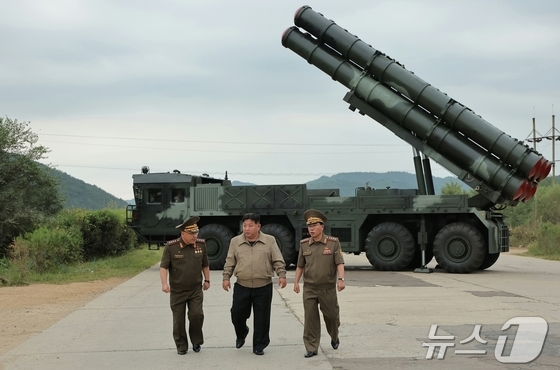
On Thursday, North Korean leader Kim Jong Un supervised a joint strike exercise involving a 600mm multiple rocket launcher and the Hwasong-11A tactical ballistic missile – both classified as short-range ballistic missiles (SRBMs) -as part of the country’s integrated nuclear weapons command system, known as the “nuclear trigger.”
According to Rodong Sinmun, the official party newspaper, the May 8 drill was intended to enhance the combat readiness of long-range artillery and missile units stationed on the eastern front.
The training was designed to help units master procedures for operating missile and artillery systems under the national nuclear command framework. Before the live-fire portion, officials conducted layered inspections of the “nuclear trigger” system to verify its reliability.
Troops also engaged in transition drills to rapidly shift into a nuclear counterattack posture, and commanders received special instruction on counterstrike operations.
Subsequent fire drills targeted various simulated enemy positions, executed individually and in coordination, based on assigned directions and distances.
North Korean media claimed that the drill achieved its objectives, asserting that the command and mobilization systems were proven capable of rapidly responding to potential nuclear crises.
Kim emphasized that nuclear forces must continuously strengthen their central role in deterrence and warfighting strategy. He called for an uncompromising commitment to keeping the nuclear force in constant operational readiness.
Highlighting the current security climate and the demands of modern warfare, Kim ordered military authorities to boost long-range precision strike capabilities and overall weapons system efficiency.
He also instructed officials to prioritize the qualitative superiority of artillery forces, describing it as essential to enhancing combat effectiveness and national defense strength.
During the event, Kim reportedly issued an “important directive” further to improve the combat reliability of tactical nuclear weapon systems and expand their operational scope.
North Korea framed the exercise as a necessary response to what it called the “reckless provocations” of the United States and its allies. The regime stated that rising military tensions in sensitive areas demand rapid response capabilities and impeccable readiness.
Officials described the drill as a concrete demonstration of North Korea’s ability to counter sudden shifts in regional security dynamics.
Kim was accompanied by senior military leaders, including Pak Jong Chon, Jo Chun Ryong, Kim Jong Sik, Jang Chang Ha (Director of the Missile Bureau), and Kim Yong Hwan (Head of the Defense Science Institute).
While the newspaper did not disclose specifics about the number or range of the missiles launched, South Korea’s Joint Chiefs of Staff reported detecting multiple SRBMs launched from the Wonsan area. The missiles reportedly flew up to 800 kilometers before landing in the East Sea.