North Korea is hosting various events to commemorate the 70th anniversary of the General Association of Korean Residents in Japan (Chongryon). Kim Jong Un, the General Secretary of the Workers’ Party, has sent a letter for the first time in a decade. Related events are taking place not only in Pyongyang but also in Tokyo, Japan. However, it is noteworthy that the letter makes no mention of unification, a principle that Chongryon has long emphasized.
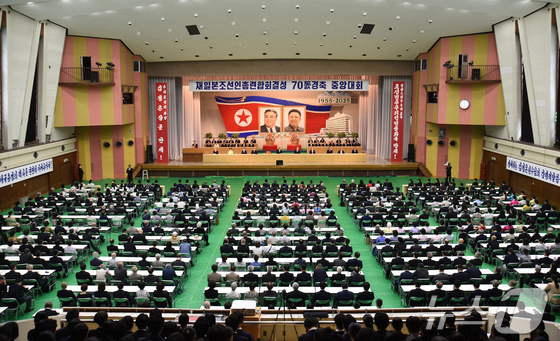
The Workers’ Party’s official newspaper, Rodong Sinmun, reported on Wednesday that a central celebration conference for Chongryon’s 70th anniversary was held at the Korean Cultural Center in Tokyo. Additionally, a central commemorative lecture took place at North Korea’s de facto embassy in Tokyo, with celebratory events occurring in various locations, including Chongryon’s Osaka headquarters.
Earlier, on May 25, Kim sent a letter to Chongryon officials and Korean residents in Japan, titled “Let’s Carry on the Patriotic Spirit of the Founding Generation and Write a Great New History for the Korean Residents’ Movement in Japan.” This marks the first such letter since the 60th anniversary in 2015.
This year’s letter was extensive, filling the first two pages of the newspaper with over 10,000 characters. Notably, it did not mention the word unification even once. Instead, it emphasized the achievements and traditions of the founding generation, focusing on the new generation and new history.
In the letter, Kim stated that the patriotic traditions left behind by the founding generation are not merely records in history books; they reside in the spirits of the descendants who bear the mission of inheritance and are reflected in the community they nurture. He stressed the need to continually strengthen education about the history and traditions of the Korean residents’ movement and to prioritize nurturing the new generation.
In contrast, during the 60th anniversary letter sent a decade ago in 2015, Kim mentioned the word unification seven times. At that time, he wrote about Chongryon and the Korean residents in Japan, emphasizing the need for them to contribute to the strengthening and development of their socialist homeland and hasten the unification of the motherland, thereby fulfilling their mission and patriotic duty to the nation and the people.
In a congratulatory message sent by the Standing Committee of the Supreme People’s Assembly of North Korea for the 65th anniversary in 2020, the emphasis was also on the autonomous unification of the homeland.
Experts believe that North Korea’s avoidance of mentioning unification to Chongryon began after it declared the inter-Korean relationship to be a hostile one between the two nations in 2023. Reports indicate that there has been internal confusion within Chongryon regarding the removal of the concepts of unification and ethnicity, as Chongryon has long aimed for autonomous, peaceful unification.
Recently, the gap in perceptions of unification between North Korea and Chongryon has widened, raising concerns about North Korea’s apparent neglect of Chongryon. Although Kim traditionally sent a congratulatory message to Chongryon to celebrate the New Year after taking power, he did not send one this year.
Looking ahead, Kim’s declaration of two nations and his stance against unification and ethnic divisions may lead to further divisions within Chongryon, requiring a reassessment of the relationship between North Korean authorities and the organization. Even if North Korean authorities demand loyalty from Chongryon, the legitimacy of Chongryon’s activities could diminish without a fundamental reestablishment of its policy direction.