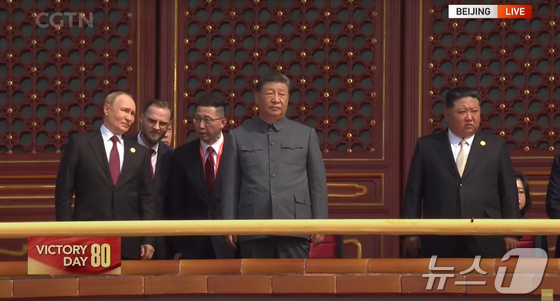
Kim Jong Un attended the Victory Day celebration in Beijing on Wednesday, commemorating the triumph over Japanese imperialism and fascism. Standing alongside Chinese President Xi Jinping and Russian President Vladimir Putin atop the Tiananmen Tower, experts view this as a significant political victory for the North Korean leader.
This marks the first time in 66 years that the leaders of North Korea, China, and Russia have convened at a single event since a Chinese national ceremony in 1959. Amid escalating U.S.-China tensions and the ongoing Russia-Ukraine conflict, concerns of a new Cold War are rising. Analysts suggest that Kim’s attendance has solidified the image of a North Korea-China-Russia alliance on the global stage.
Although China has historically practiced a deliberate distancing policy regarding North Korea—a strategy sometimes referred to as the North Korea-China-Russia distancing—experts argue that Kim’s presence has fostered a sense of potential unity among the three nations when required. This alone is regarded as a substantial gain for Kim, despite the low likelihood of immediate concrete cooperation.
Analysts further noted that through this platform, Kim has secured strategic alliances with both China and Russia, attracted U.S. attention with this display of solidarity, and bolstered his image as a legitimate global leader.
Kim Jong Un’s International Debut: Unprecedented Protocol and Political Triumph
Professor Park Won-gon of Ewha Womans University’s North Korean Studies Department remarked that Kim received far higher protocol than anticipated during this Victory Day. Further noting that his presence in the front row alongside Presidents Xi and Putin itself demonstrates North Korea’s elevated status.
Park emphasized that while representatives from 26 countries attended, the top three at the tower—apart from China—were Russia and North Korea. He highlighted the symbolic significance of this arrangement, considering that all three are nuclear powers.
Park added that Kim achieved something his predecessors, Kim Il Sung and Kim Jong Il, never did — standing directly beside the Chinese leader. He added that this platform represents a clear political victory for Kim.
Professor Kim Jung of the University of North Korean Studies stated that by maintaining close ties with Russia while securing robust support from China, Kim has gained a powerful bargaining chip for future negotiations with the U.S.
He further observed that Kim’s decision to bring his daughter, Kim Ju-ae, appears aimed at cementing the succession plan in the eyes of the international community. This Victory Day event could also strengthen his domestic political stability.
North Korea Creates Illusion of Parity with China and Russia: Potential Leverage in U.S. Negotiations
Oh Kyung-seop, a research fellow at the Korea Institute for National Unification, commented that by standing alongside Putin and Xi, North Korea has created an illusion of parity with Russia and China on the global stage. Further noting that this is likely to significantly boost Kim’s confidence in future U.S.-North Korea negotiations.
Oh also suggested that Kim might leverage this North Korea-China-Russia cooperation to intensify pressure on the U.S. for sanctions relief.
Yang Wook, a research fellow at the Asan Institute for Policy Studies, noted that from Kim’s perspective, showcasing his reception to the world through live broadcasts sends a strategic message to the U.S.
However, Yang cautioned that China is unlikely to officially recognize North Korea as a nuclear power or send overt signals of support. He concluded that China’s goal is to utilize North Korea without becoming excessively dependent on the North Korea-Russia alliance.