

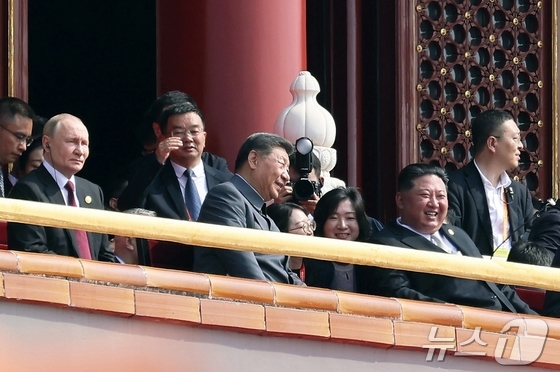
North Korean Workers’ Party General Secretary Kim Jong Un stood alongside Chinese President Xi Jinping and Russian President Vladimir Putin at the Tiananmen Tower during the 80th-anniversary military parade celebrating China’s Victory Day on September 3. This event marked the first appearance of a North Korean leader on a multilateral diplomatic stage in 66 years, following Kim Il Sung’s participation in the People’s Republic of China’s 10th-anniversary celebration in October 1959.
Kim received special diplomatic treatment from China and conducted separate bilateral talks with both Presidents Putin and Xi. This event was not merely about strengthening an anti-U.S. alliance or forming an anti-Western bloc; rather, it signaled a new chapter in North Korea’s relations with China and Russia as they seek to reshape the global order into a multipolar system.
Notably, prior to attending the Victory Day event, Kim had unveiled a detailed foreign policy strategy between late July and mid-August to address the shifting geopolitical landscape. This strategy was communicated during a meeting of North Korea’s Foreign Ministry directors, chaired by Kim Yo Jong, on August 19.
At the core of this strategy is the need for proactive diplomatic responses to nations perceived as threats to North Korea’s national sovereignty—specifically, South Korea, the U.S., and Japan—while also maneuvering rapidly evolving regional and global geopolitical situations to North Korea’s advantage. Within this framework, three key diplomatic directions appear to have been proposed.
First, North Korea aims to portray South Korea’s conciliatory efforts as deceptive and double-faced, urging the international community to recognize the adversarial nature of the North-South Korean relationship as that of two separate states. Kim Yo Jong warned that South Korea, deemed insincere and lacking in gravitas, would not even play a minor role in regional diplomacy centered on North Korea. This implies that scenarios such as the 2019 trilateral meeting at Panmunjom involving the two Koreas and the U.S. are unlikely to recur.
Second, North Korea plans to develop targeted strategies to address nations that align with South Korea’s stance. This includes actively countering South Korea’s international diplomatic efforts aimed at pressuring North Korea towards denuclearization.
Third, North Korea intends to strengthen its strategic alliances with China and Russia to solidify an anti-imperialist peace coalition and oppose U.S. hegemony in international forums such as the United Nations (UN), thereby safeguarding their shared interests.
In this context, Kim’s attendance at China’s Victory Day parade and the subsequent summits with Russia and China can be seen as the launch of this new foreign policy strategy. Through these events, North Korea appears to have secured several tangible gains.
Primarily, by standing alongside Presidents Xi and Putin, Kim appears to have affirmed North Korea’s status as a strategic player opposing U.S. hegemony.
Notably, during the summit with Kim, President Xi omitted any mention of denuclearization from China’s long-established three principles regarding the Korean Peninsula—peace and stability on the Korean Peninsula, denuclearization, and resolution through dialogue and negotiation. While this might have been a one-time gesture given Kim’s presence at the event, many interpret it as China effectively acknowledging North Korea as a nuclear state. This marks the removal of a major obstacle that had strained North Korea-China relations, representing a significant diplomatic victory for North Korea in its efforts to cement its nuclear status.
China’s indirect endorsement of North Korea’s nuclear status—departing from its steadfast advocacy for a denuclearized Korean Peninsula—appears to be a strategic move to counter the burgeoning U.S.-South Korea nuclear cooperation, the modernization of their alliance, and the enhanced security ties among South Korea, the U.S., and Japan.
North Korea has also gained momentum in potentially easing international economic sanctions. During his meeting with Xi, Kim emphasized their commitment to protecting mutual interests in multilateral forums like the UN, signaling intentions to collaborate with allies such as China and Russia in opposing the U.S.
Kim expressed firm support for China’s core interests concerning Taiwan, Tibet, and Xinjiang, a stance that likely secured China’s commitment to joint efforts aimed at lifting sanctions against North Korea. This development, combined with the North Korea-Russia alliance, suggests that North Korea may be finding ways to circumvent UN sanctions, potentially removing barriers to enhanced economic cooperation between North Korea and China.
South Korean Unification Minister Chung Dong-young acknowledged that Kim’s participation in China’s Victory Day parade has widened loopholes in sanctions, suggesting that the two-decade-long strategy of using sanctions to achieve denuclearization has proven ineffective.
Leveraging China’s shifting stance on sanctions, Kim underlined the need for active economic engagements and support. Unlike previous summits, Kim openly expressed hopes for enhanced exchanges in party-building and economic development, to which Xi responded with promises of practical cooperation across various sectors.
For Kim, securing Chinese support and economic cooperation is essential for the success of North Korea’s upcoming five-year economic plan and its ongoing large-scale local construction projects.
Infrastructure developments, including the expansion of border customs facilities and the completion of the New Yalu River Bridge, indicate a readiness for increased North Korea-China exchanges in trade and tourism, pending approval from the central government.
Xi’s statement of support for North Korea’s developmental path and its socialist cause with North Korean characteristics could have broader ramifications for North Korea’s nuclear ambitions and its approach toward South Korea and the U.S. This development poses a significant diplomatic challenge for South Korea’s government, which is already contending with U.S. trade pressures.
Should North Korea launch a diplomatic offensive in multilateral forums based on Kim’s new foreign policy, it could considerably complicate South Korea’s efforts to resume inter-Korean dialogue and exchanges.
As future North Korea-U.S. summits loom on the horizon, South Korea must prepare for the possibility of being sidelined from its self-appointed role as facilitator. A broader perspective beyond inter-Korean relations will be necessary, one that focuses on establishing new frameworks for international cooperation linking South Korea, North Korea, China, and Russia—through initiatives such as railway connections and joint development projects in Russia’s Far East.