

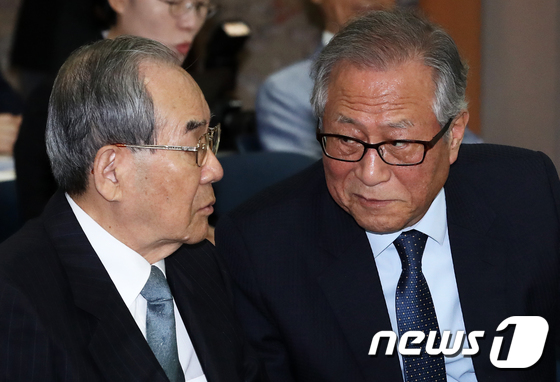
Former South Korean unification ministers have characterized the upcoming regular consultations between South Korea and the U.S., scheduled to begin on Tuesday, as a second U.S.-South Korea working group. They firmly stated that North Korea policy cannot be entrusted to the Ministry of Foreign Affairs.
The former ministers—Im Dong-won (25th and 27th), Jeong Se-hyun (29th and 30th), Lee Jae-jung (33rd), Cho Myung-kyun (39th), Kim Yeon-chul (40th), and Lee In-young (41st)—issued a joint statement on this matter. They emphasized that while South Korea and the U.S. must closely consult on North Korea policy, reverting to the previous U.S.-South Korea working group model is ill-advised. They criticized the working group for its counterproductive role in hindering inter-Korean relations and raising sanctions thresholds, rather than effectively solving problems.
The former ministers argued that the Ministry of Foreign Affairs, lacking expertise and understanding of inter-Korean relations, cannot be trusted with North Korea policy. They asserted that the Ministry of Unification is the primary agency for North Korea policy, designed to facilitate inter-agency consultations across economic, military, humanitarian, and socio-cultural domains.
They called for an immediate halt to the Foreign Affairs-led U.S.-South Korea working group plan. Instead, they advocated for a strategy centered on the Ministry of Unification to revitalize inter-Korean relations. They stressed the need to support President Donald Trump in finding a path to a successful North Korea-U.S. summit.
The U.S.-South Korea working group, established in 2018, serves as an official communication channel between diplomatic authorities and a separate consultation body. It encompasses all relevant agencies, primarily the Ministry of Foreign Affairs and the U.S. State Department. The group was intended as a unified platform for sharing information and discussing inter-Korean cooperation during denuclearization negotiations. However, it faced criticism when the U.S. expressed concerns about inter-Korean relations outpacing North Korea-U.S. negotiations, leading to perceived obstruction of inter-Korean exchanges.
The former ministers highlighted the clear divergence in North Korea policy views between President Trump and his administration’s working-level departments. They cautioned that consulting with U.S. officials on North Korea policy could potentially worsen, rather than improve, inter-Korean relations.
They further argued that allowing the Ministry of Foreign Affairs to lead North Korea policy contradicts constitutional principles and the Government Organization Act. They pointed out that historically, the Ministry of Foreign Affairs has taken a more negative and conservative stance than the U.S. government on issues like the Kaesong Industrial Complex and easing sanctions on North Korea.
South Korea and the U.S. are set to commence regular consultations on North Korea policy from Tuesday. Jeong Yeon-du, head of the Foreign Affairs Strategy and Information Bureau, and Kevin Kim, Deputy Chief of Mission at the U.S. Embassy in South Korea, will lead their respective delegations. Reports suggest that the Ministry of Unification is considering boycotting these consultations, deeming it inappropriate for the Ministry of Foreign Affairs to spearhead North Korea policy coordination.