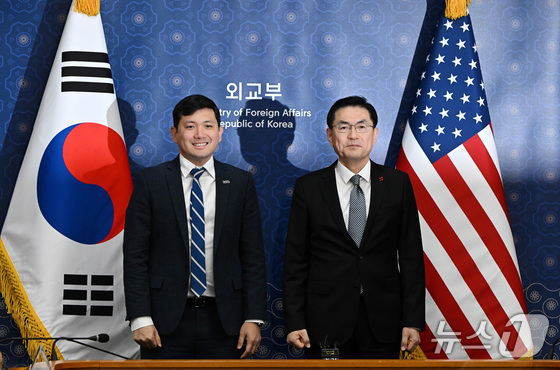
On Tuesday, the U.S. and South Korea held a Follow-up Consultation on the Joint Fact Sheet from the U.S.-South Korea Summit to coordinate their North Korea policies. Both nations plan to hold regular meetings to discuss various North Korean issues.
Media attention focused on the U.S. chief representative during the meeting. This was due to visible tensions between the Ministry of Foreign Affairs and the Ministry of Unification over who would lead discussions on North Korea. Kevin Kim, the U.S. Deputy Ambassador to South Korea, who had previously called for moderation in the government’s conciliatory approach toward North Korea, served as the chief representative for this consultation.
On December 8, Deputy Ambassador Kim met with First Vice Minister Park Yoon-joo at the Ministry of Foreign Affairs. During that visit, he emphasized to reporters the critical importance of U.S.-South Korea cooperation, stating that joint military exercises are vital and should continue in their current form.
Some interpreted Kim’s remarks as conveying the U.S. administration’s unease regarding the progressive faction within the Yoon administration, which focuses on resolving inter-Korean issues bilaterally. This interpretation arose after Unification Minister Chung Dong-young stated on November 25 that waiting for U.S. approval cannot resolve Korean Peninsula issues, and suggested reducing joint U.S.-South Korea military exercises to encourage dialogue with North Korea.
Notably, it’s unusual for officials to disclose their positions to the media during informal diplomatic meetings, leading to speculation that Kim’s statements were pre-planned.
During his encounters with the press, Deputy Ambassador Kim refrained from commenting on the meeting’s outcomes or the conflict between the progressive and alliance factions regarding North Korea policy.
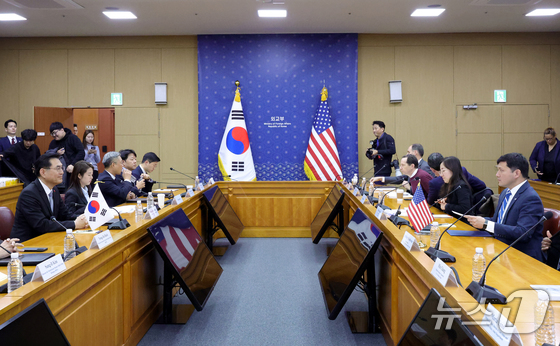
Aware of Scrutiny Over Intervening in the Conflict Between the Pro-Independence Faction and the Pro-Alliance Faction… U.S. Expected to Observe the Situation in South Korea for the Time Being
Observers noted that Kim’s low-key approach might stem from a desire to avoid exacerbating tensions between the progressive and alliance factions, especially after his previous remarks drew criticism for seemingly fueling those conflicts.
Analysts believe that the U.S. and the alliance faction share similar positions, so they may have felt the need to distance themselves from the perception that this issue represents a conflict between the progressive faction and the U.S.-aligned group.
Before the consultation, the Ministry of Foreign Affairs described the meeting as a Regular Consultation for Coordinating North Korea Policy, but changed the name to Follow-up Consultation on the Joint Fact Sheet from the U.S.-South Korea Summit just before it began. This change likely aimed to prevent escalating conflicts within the government, particularly given the Unification Ministry’s opposition to Foreign Affairs-led discussions on North Korea issues.
Changing the consultation’s name requires U.S. agreement, suggesting that Kim’s silence may implicitly indicate that the U.S. will not intervene in South Korea’s internal matters.
However, some worry that the U.S.’s low-key approach could slow down U.S.-South Korea cooperation on North Korea policy.
The presidential office has announced plans to make next year pivotal for resuming inter-Korean dialogue and advancing the Peaceful Coexistence Process on the Korean Peninsula. They aim to use President Donald Trump’s visit to China in April as an opportunity to facilitate contact with North Korea. However, some speculate that the U.S. may take a passive stance in U.S.-South Korea consultations, citing the need to let the situation in South Korea stabilize.
Professor Park Won-gon from Ewha Womans University stated that from the U.S. perspective, they likely want to avoid any misunderstandings or criticisms about interfering in South Korean government affairs. However, this could negatively affect policy coordination on North Korea and denuclearization if the U.S. and South Korea have not yet engaged in proper discussions.