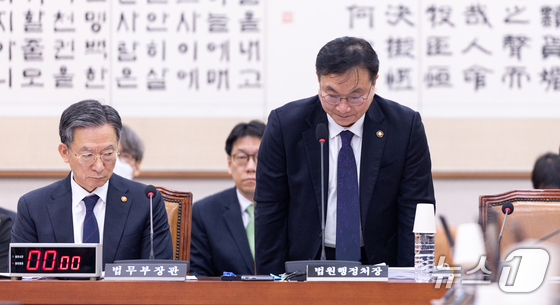
On Wednesday, tensions erupted between the ruling and opposition parties during the first appearance of Park Young-jae, the newly appointed head of the Supreme Court Administrative Office, before the National Assembly’s Legislative and Judiciary Committee. Park, who took office last month, previously served as the chief justice in President Lee Jae Myung’s election law violation case, which the Supreme Court remanded for retrial last May with a guilty verdict.
The Democratic Party of Korea called for Park’s resignation, claiming he nearly erased the presidential election date. Committee Chairperson Choo Mi-ae stated that the Supreme Court justice nominated as Administrative Office head almost caused them to lose last year’s June 3 presidential election date.
Democratic Party lawmaker Kim Yong-min argued that last year’s presidential election was nearly non-existent or potentially distorted. He should apologize properly and consider resigning. Another Democratic Party member, Kim Ki-pyo, demanded Park’s resignation, saying that it’s unacceptable that the chief justice responsible for a crucial ruling that undermined public trust in the judiciary now represents the court before the National Assembly and the public.
In response, Park stated that he can only say that the previous unanimous ruling was made in accordance with the Constitution and laws, following proper procedures. He will do my utmost to ensure public confidence in the trial process and its outcome. When asked by Democratic Party lawmaker Jeon Hyun-hee if he had read all the trial records as chief justice, Park replied that he had read everything necessary.
The People Power Party countered the Democratic Party’s attacks, claiming they were undermining judicial independence. Lawmaker Joo Jin-woo from the People Power Party criticized that a country that mocks and pressures the judiciary under the guise of representing the people’s will is a dictatorship, comparing it to North Korea and Venezuela. Another lawmaker, Song Seok-jun, added that the legislative branch is one of the three powers alongside the executive and judiciary, not an institution that dominates the courts.
Park expressed concerns about the Democratic Party’s proposed judicial reform legislation. Regarding the proposed crime of judicial distortion, he aligned with previous heads’ opinions, stating it risks infringing upon judicial independence and has subjective criteria. He described the introduction of trial petitions as a move toward a four-tier system and warned that increasing Supreme Court justices could significantly weaken lower courts.
The meeting escalated into a heated exchange between People Power Party lawmaker Na Kyung-won and Chairperson Choo. When Na asked on is it wrong to call President Lee, who is on trial, a criminal president after receiving a guilty verdict from the Supreme Court? Choo responded by denying her the floor and ordering her to leave. As tensions rose, with Choo telling members to stop filming, People Power Party members protested and exited the meeting.
In other business, the Legislative and Judiciary Committee processed several bills, including amendments to the Civil Code, which had passed through the subcommittee led by the ruling party the previous day. The key amendment allows for the revocation of inheritance rights for heirs who severely neglect their duty to support the deceased or commit serious crimes.