Following the Lunar New Year holiday, the Lee Jae Myung administration is expected to face significant challenges in its pragmatic diplomacy. This is due to several upcoming events: the 9th Congress of the Workers’ Party of North Korea scheduled for late this month, negotiations on introducing nuclear-powered submarines and amending the U.S.-South Korea nuclear cooperation agreement expected in late February to early March, and the U.S.-Japan summit planned for March.
These diplomatic events are likely to present serious strategic tasks for South Korea regarding its security situation and diplomatic relations with the U.S. and China.
9th Party Congress Set for Late February, With Tougher Anti-South Policy and Nuclear Buildup Anticipated
North Korea plans to hold its 9th Congress of the Workers’ Party in Pyongyang in late February. This marks the first such event in five years since the 8th Congress in 2021 and serves as a crucial political occasion to outline the government’s direction for the next five years.
Kim Jong Un has publicly stated that he will propose a dual strategy of strengthening both nuclear and conventional military capabilities at the 9th Congress. On January 27, he emphasized that building the most reliable offensive capabilities and implementing a deterrence strategy based on that is the unwavering policy of their party’s national defense. He added that the 9th Congress will announce the next steps to further enhance the country’s nuclear war deterrence.
Consequently, North Korea is expected to unveil new nuclear weapons development plans aimed at upgrading its existing weapon systems during this Congress. There’s also a possibility that North Korea will establish a new nuclear strategy in line with its dual approach and incorporate it into the Nuclear Force Policy Law enacted in 2022.
Additionally, it’s crucial to monitor the enhancement of conventional military capabilities. North Korea has already diversified its weapons by improving short-range ballistic missiles and multiple rocket launchers. However, North Korea claims that conventional weapons can also be equipped with nuclear warheads, and it’s expected to significantly increase the production of conventional weapons to heighten the threat of saturation attacks against South Korea.
Furthermore, there are suggestions that North Korea may present comprehensive plans involving the development of precision guidance systems for drones and missiles integrated with artificial intelligence (AI) and additional launches of reconnaissance satellites.
The policy framework declared in December 2023 regarding the hostile relationship between the two nations may also be specifically reflected in the party’s charter, with decisions to incorporate related content into the constitution in the future. This is seen as an attempt to reduce the variability of its North-South and external policies and to solidify a permanent two-nation framework.
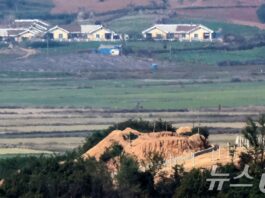
Experts express concerns that North Korea may use the Congress and the subsequent Supreme People’s Assembly to solidify the party’s and legal basis for the two-nation framework. This could potentially lead to designating the Military Demarcation Line (MDL) as a border and declaring new territorial waters at sea, thereby undermining the existing division system, including the Northern Limit Line (NLL).
South Korea, U.S. Start Talks on Nuclear-Powered Subs as Reciprocal Tariff Concerns Continue
South Korea and the U.S. plan to hold practical negotiations at the end of this month or early next month. These talks will cover technical cooperation for introducing nuclear-powered submarines, amendments to the nuclear cooperation agreement, and maintenance, repair, and overhaul (MRO) cooperation for the vessels. A U.S. interagency delegation, including representatives from the National Security Council (NSC), State Department, Department of Energy, and Department of Defense, is expected to visit South Korea.
The challenge lies in the fact that discussions on security matters such as the introduction of nuclear submarines and nuclear cooperation are intertwined with issues related to reciprocal tariffs and U.S. investment commitments.
Last November, South Korea and the U.S. agreed on a large-scale investment of approximately 350 billion USD, adjusting reciprocal tariffs from 25% to 15%. The South Korean government is pushing for the passage of a Special Law for U.S. Investments to support the expansion of investments in the U.S. However, the Donald Trump administration has warned that if discussions in the South Korean National Assembly remain stagnant, it may revert reciprocal tariffs back to 25%.
Both ruling and opposition parties are accelerating legislative efforts by preparing plans to form a special committee to discuss the passage of the Special Law for U.S. Investments. However, the actual timing for the new law’s passage in the National Assembly is expected to be around March 9 at the latest. In diplomatic circles, there are concerns that if a clear schedule for the passage of the special law is not established by early next month, the U.S. may delay the practical negotiation schedule as a means of increasing pressure and expressing dissatisfaction.
The White House expressed a somewhat relaxed attitude on Monday regarding the formation of a special committee in the South Korean National Assembly to expedite the passage of the special law, calling it positive progress. However, there is a prevailing sentiment within the U.S. administration that it will continue to leverage South Korea’s non-tariff barriers as a negotiating tool if improvements are not made.
March U.S.–Japan Summit Ahead—Could a More Assertive Japan Pose Challenges for South Korea?
Japanese Prime Minister Sanae Takaichi achieved a significant victory in the House of Representatives election held on February 8, where the ruling Liberal Democratic Party secured two-thirds of the seats, marking the greatest victory since World War II. This victory significantly strengthens the Kishida administration. With the slogan of a strong Japan, Kishida is likely to amplify his voice in diplomacy based on his solid support base.
Amid this situation, Takaichi plans to visit the U.S. on March 19 for a summit with President Trump. Having already gained strong support from the U.S. during his election campaign, this visit is expected to solidify Japan’s influence.
Particularly during the current phase of China-Japan tensions, Takaichi’s goal may be to overcome the defensive position by strengthening pressure on China through U.S. support. In this process, the U.S. and Japan may urge South Korea to become more involved in countering China as part of strengthening trilateral cooperation. Additionally, Japan may commit to active investment in the U.S., potentially taking a proactive stance on defense spending increases, which has been lukewarm until now. This could also pose a burden for South Korea, which faces pressure to expedite its investments in the U.S.
Moreover, the upcoming Takeshima Day event in Shimane Prefecture on February 22 adds another variable. Takaichi has previously argued for elevating the status of the Takeshima Day event, so if this year’s event is significantly grander than in previous years, it could strike a severe blow to Japan-South Korea relations.