

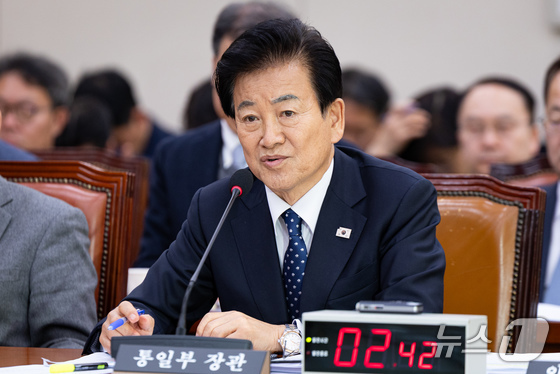
On March 6, South Korean Unification Minister Chung Dong-young identified three locations in North Korea where uranium enrichment facilities are operational: Yongbyon, Kangson, and Kusong.
The mention of Kusong, in addition to the previously confirmed sites of Nyongbyon and Kangson by the International Atomic Energy Agency (IAEA), has sparked speculation that the government may have uncovered new nuclear facilities.
During a National Assembly Foreign Affairs and Unification Committee session, Minister Chung responded to an inquiry from People Power Party representative Kim Ki-hyun, confirming that North Korea’s nuclear capabilities continue to expand.
Jeong referenced the report presented by IAEA Director General Rafael Grossi at the recent board meeting, stating that intelligence indicates that the 5MW reactor at Nyongbyon is currently operating in its seventh cycle.
He elaborated that the reactor has been running continuously since January 2025, surpassing a year of operation. Over the past three decades, approximately 100 kg (about 220 lbs) of plutonium has been extracted from six cycles of spent fuel rod processing. It’s estimated that about 16 kg (about 35 lbs) of plutonium was obtained through the sixth reprocessing last year.
Notably, Minister Chung disclosed that high-enriched uranium (HEU) production is ongoing at enrichment facilities in Nyongbyon, Kusong, and Kangson.
He drew a stark comparison, stating that while the recently U.S.-bombed facility in Iran was producing 60% enriched uranium, North Korea is believed to be enriching weapons-grade uranium to 90%. Director General Grossi’s report also indicated ongoing expansion of the Nyongbyon enrichment facility.
Although Minister Chung referenced Kusong while discussing Grossi’s speech, the IAEA chief’s actual remarks only mentioned Nyongbyon and Kangson. To date, the South Korean government has only publicly confirmed these two locations as North Korea’s uranium enrichment sites.
A Unification Ministry spokesperson later clarified that the minister’s comments referred to open-source information from organizations like the Institute for Science and International Security (ISIS). The government cannot independently verify this information at this time.