

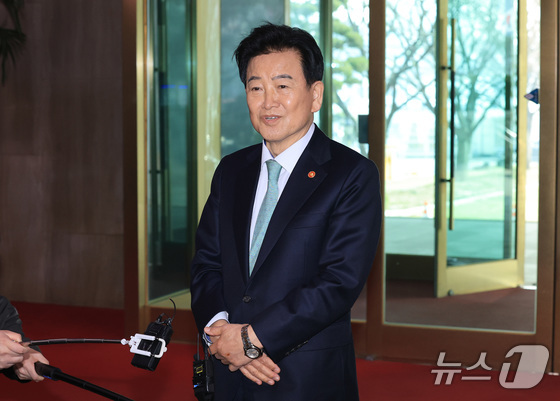
On Monday, Minister of Unification Chung Dong-young affirmed that the South Korean government’s co-sponsorship of the United Nations (UN) Human Rights Council’s resolution on North Korean human rights does not compromise its policy of peaceful coexistence.
Speaking to reporters at the Government Complex in Seoul, Minister Chung clarified that the Ministry of Unification has maintained a consistent stance since last year. The decision to co-sponsor was reached through inter-departmental coordination within the government.
Earlier, on March 26, he had suggested that it would be preferable not to co-sponsor, stating that North Korea views human rights issues as a prime example of hostile policy. It has no compelling reason to push this agenda, given the potential risks. The government had reportedly been cautious about co-sponsorship, considering the need to build trust while working to restart inter-Korean dialogue.
However, recognizing the importance of international cooperation on North Korean human rights, the government finalized its decision to participate on March 28. The Ministry of Foreign Affairs explained that it will co-sponsor the North Korean human rights resolution, collaborating with the international community to tangibly improve the human rights situation for North Korean citizens.
Addressing claims that the government’s sudden shift to co-sponsorship was due to North Korea’s persistent hostile two-state policy rendering South Korea’s participation inconsequential, Minister Chung said that he sees this as striking a balance between respecting UN authority and maximizing respect for the other party’s sovereignty.
The North Korean human rights resolution, drafted by the European Union (EU) and Australia, is set for adoption on Monday at the 61st session of the UN Human Rights Council in Geneva.
The UN adopts resolutions on North Korean human rights biannually: at the Human Rights Council in the first half of the year and at the UN General Assembly in the second half. South Korea co-sponsored these resolutions from 2008 to 2018 but abstained from 2019 to 2021, citing inter-Korean relations. In 2022, following President Yoon Suk Yeol’s inauguration, South Korea resumed its role as a co-sponsor.