

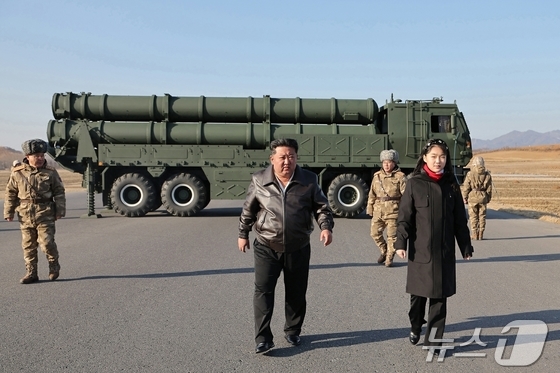
A new analysis released on Tuesday reveals that Kim Jong Un, the General Secretary of North Korea’s Workers’ Party, has increasingly focused his public activities on military and defense sectors during the first quarter of this year. This trend appears to align with Kim’s emphasis on bolstering military capabilities, including various ballistic missile tests, earlier in the year.
According to the Kim Jong Un Public Activity Analysis by the Unification Research Institute, the individual with the most frequent appearances alongside Kim through March 24 was Kim Jong-sik, First Deputy Director of the Workers’ Party’s Munitions Industry Department, with four appearances. Following him were Ri Il-hwan, a Politburo Standing Committee member (three appearances), Jo Chun-ryong, Director of the Munitions Industry Department (two appearances), Kim Jae-ryong, another Politburo Standing Committee member (two appearances), and Jang Chang-ha, Director of the Missile Development Agency (two appearances).
Kim Jong-sik, a former rocket engineer, has been a key figure in North Korea’s defense industry for years. He was awarded the title of, Hero of the Republic, in 2012 for his contributions to missile development during Kim’s first year in power. In August 2016, he gained significant attention when photographed smoking alongside Kim during a submarine-launched ballistic missile (SLBM) test. More recently, Kim Jong-sik was seen cheering next to Kim during the launch of North Korea’s first reconnaissance satellite, Malligyong-1, in November 2023.
Jang, a high-ranking official with a technical background, has made substantial contributions to missile technology development, having previously served as head of the Defense Science Institute. He is frequently present at major missile launch sites and often issues launch orders on Kim’s behalf.
Following South Korea’s successful test of its indigenous SLBM in 2021, Jang released a statement five days later, showcasing his role as a technical expert. He criticized South Korea’s military capabilities, calling their weapons substandard and questioning whether they were truly submarine-launched ballistic missiles.
Both Kim Jong-sik and Jang have played crucial roles in advancing North Korea’s strategic weapons programs, including the transition from liquid to solid fuel for ballistic missile propulsion systems and enhancing hypersonic technology.
In April, Kim has focused on testing improved versions of existing missiles and newly developed systems. Recent demonstrations have included previously unseen weapons, such as cluster munitions carrying multiple submunitions and carbon fiber bombs designed to disrupt power systems by releasing nickel and carbon fibers upon detonation. It’s likely that Kim Jong-sik and Jang contributed to the development of these new weapon systems.
Jo, who oversees military supplies as head of the Munitions Industry Department, is known to have studied weapons-related technologies abroad. He is recognized more for his expertise in heavy industry technology for military logistics than for traditional military roles. His prominence has grown since around 2014, following Kim’s rise to power.
North Korea refers to its military economy as the Second Economy to distinguish it from the civilian sector. Jo is believed to have led the Second Economy Commission, overseeing military economic activities around 2014-2015. Given the limited public information about his activities and background, some analysts speculate that he may be a key strategist behind North Korea’s military logistics.
In November 2016, Jo was designated as a travel ban target for South Korea and the U.S. under the United Nations (UN) Security Council Resolution 2321. He is also listed on both countries’ independent sanctions lists.
Analysts suggest that the increased presence of these key missile and military industry figures alongside Kim this year correlates with North Korea’s recent military displays, including four demonstrations of strategic weapons this month alone.
In February, Kim established a new five-year defense development plan at the 9th Workers’ Party Congress. During the commemorative parade, he actively called for strengthening military capabilities, declaring that it must continuously grow stronger as a force that the enemies fear.