

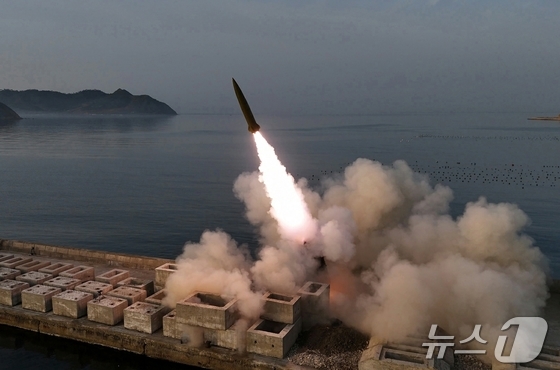
South Korea has suspended sharing certain intelligence on North Korea following Unification Minister Chung Dong-young’s disclosure of North Korean uranium enrichment facilities, which the U.S. deemed unauthorized. This move has sparked concerns about potential gaps in South Korea’s monitoring and preparedness capabilities, particularly in light of North Korea’s recent ballistic missile test on April 19, raising questions about the effectiveness of U.S.-South Korea communication.
Minister Chung’s controversial remarks were made during a National Assembly Foreign Affairs and Unification Committee meeting on March 6. He stated that North Korea is operating uranium enrichment facilities not only in Yongbyon and Gangseon but also in Guseong.
Chung cited a report by the International Atomic Energy Agency (IAEA) Director General Rafael Grossi, which indicated the presence of uranium enrichment facilities in Yongbyon, Guseong, and Gangseon. These facilities are reportedly producing weapons-grade uranium at 90% enrichment, surpassing Iran’s 60% enriched uranium.
While U.S. and South Korean intelligence agencies have not officially confirmed nuclear facilities in Guseong, North Pyongan Province, a 2016 report by the Institute for Science and International Security (ISIS) suggested the presence of initial centrifuge research and development facilities near Banghyeon Air Force Base. Many experts consider nuclear activities in this area to be a given.
Unification Ministry spokesperson Yoon Min-ho reaffirmed that Minister Jeong’s statements were based on publicly available information, citing the ISIS report, a 2024 interview with RAND Corporation’s Dr. Bruce Bennett, and a 2025 report from the Center for Strategic and International Studies (CSIS).
Despite the Unification Ministry’s claims of providing sufficient explanations to the U.S., Washington responded by suspending intelligence sharing on North Korea, an unprecedented move.
It is believed that the U.S. is now withholding certain satellite imagery and signals intelligence on North Korea from South Korea. The U.S. reportedly monitors North Korean activities using spy satellites and high-altitude reconnaissance aircraft such as the U-2S and RC-12X Guardrail.
The U-2S, an upgraded version of the Cold War-era spy plane, can detect movements up to 160 km (about 99 miles) away using advanced radar and ultra-high-resolution cameras. This capability allows it to monitor troop movements and mobile missile launchers both near the demilitarized zone (DMZ) and deep within North Korea. The Guardrail aircraft specializes in communications and signal intelligence, enabling early detection of potential missile launches.
Yang Wook, an analyst at the Asan Institute for Policy Studies, warned that delays in sharing U.S. intelligence could be critically detrimental to South Korea’s security posture. He emphasized that U.S. reconnaissance data provides a comprehensive picture of North Korean activities, drawing from assets on the Korean Peninsula, the U.S. mainland, and Japan.
The South Korean Defense Ministry maintains that there are no issues with readiness, asserting that U.S. and South Korean forces continue to share critical information within their combined defense framework. They claim that collaboration on immediate threats, such as the recent Hyunmoo-11 missile test on April 19, remains unaffected.
However, some experts argue that even seemingly less critical information is vital for building a comprehensive intelligence picture. They warn that a prolonged intelligence gap could significantly impact South Korea’s ability to respond to security threats. Delays in sharing time-sensitive military intelligence could undermine the establishment of a robust defense posture.
The restrictions on information sharing also raise concerns about potential miscalculations that could escalate regional tensions. A February incident where U.S. forces conducted unannounced aerial training over the Yellow Sea, resulting in a tense encounter with Chinese fighter jets, highlights the risks of reduced coordination.
Um Hyo-sik, a former Joint Chiefs of Staff spokesperson now with the Korea Defense and Security Forum, stressed the critical importance of timely intelligence sharing. He noted that U.S. reconnaissance capabilities are still considered superior, and warned that continued limitations on information exchange could lead to long-term vulnerabilities in South Korea’s defense readiness.
Some analysts argue that if the U.S. measures are indeed excessive, the South Korean government should voice its concerns more forcefully. They suggest leveraging South Korea’s own intelligence contributions to the alliance as a basis for demanding more equitable information sharing.
Cho Sung-ryeol, a military studies expert at Kyungnam University, pointed out that South Korea also provides valuable Signals Intelligence (SIGINT) and Human Intelligence (HUMINT) to the U.S. He advocated for a more assertive approach in addressing legitimate grievances within the intelligence-sharing relationship.