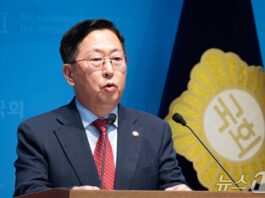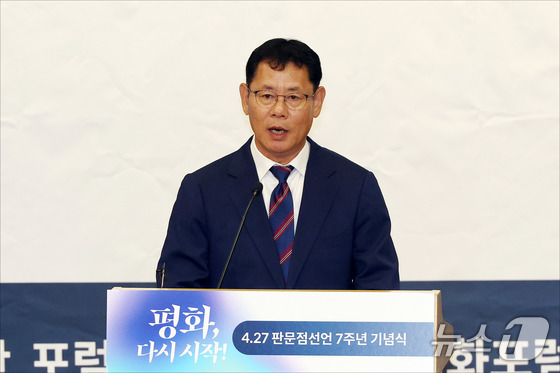
Kim Yeon-cheol, chairman of the Korea Peninsula Peace Forum and former Minister of Unification, referenced North Korea’s “hostile two-state theory” and asserted that now is not the time to attempt engagement with North Korea.
Kim made these remarks on Thursday afternoon at the 4th Moon Ik-hwan Peace Forum, held in the main conference hall of the Jang Gong Memorial Building at Hanshin University in northern Seoul.
He emphasized that North Korea is wary of and hostile to the changes that engagement could bring.
Kim continued that the Lee Jae Myung administration has been trying to elicit a response from North Korea through proactive measures to ease tensions. However, without dialogue, it cannot build trust. If North Korea persists in its hostility toward South Korea to maintain its regime, there will be limits to reducing tensions between the two Koreas.
Kim stressed that fundamentally, North Korea’s hostile two-state theory and South Korea’s concept of peaceful coexistence are distinct ideas. He explained that the notion of hostile two states is closer to hostile coexistence, which resembles the relationship where U.S. and Israeli military interventions justify the oppressive politics of the Iranian regime.
He added that hostile coexistence is far from peace and thrives in an environment of confrontation and war. In contrast, peaceful coexistence that acknowledges differences and seeks common ground is only possible in an environment of peace, not violence.
Kim stated that North Korea’s stance is generally composed of three concepts: anti-unification, hostility, and the two-state structure, where hostility has solidified the structural characteristics of anti-unification and the two states. He noted that hostility is a major component of the division system, and opposing unification does not eliminate hostility because the very existence of the two states is the root cause of this hostility.
He concluded that recognizing the two states does not automatically lead to peace. The key challenge lies in how to ease and eventually dismantle the structure of hostility.