North Korea strongly criticized recent statements by U.S. military leaders regarding the expanded role of American forces in South Korea, aligning itself with China’s position.
As speculation grows about a potential visit by Chinese President Xi Jinping to North Korea, analysts suggest that Pyongyang’s public support for Beijing indicates a deepening relationship between the two nations.
On Wednesday, North Korea’s state-run Korean Central News Agency published an op-ed by international affairs commentator Kim Myung-cheol, who referenced recent remarks made by General Xavier Brunson, commander of U.S. Forces Korea, and criticized America’s strategy to counter China.
Previously, at an event in Hawaii last month, Brunson described South Korea as an island or a fixed aircraft carrier floating between Japan and mainland China, emphasizing its critical role in regional operations beyond just deterring North Korea. He notably likened U.S. forces in South Korea to a dagger aimed at China, provoking a strong backlash from Beijing.
In his op-ed, Kim argued that Brunson’s comments reflect not just personal opinions but a calculated perspective from the U.S. administration. He criticized Washington for attempting to mobilize its allies in a strategy aimed at countering China.
North Korea’s reaction aligns closely with criticisms from China.
On May 28, a spokesperson for the Chinese embassy in South Korea publicly criticized Brunson’s remarks, stating they clearly crossed a line. The spokesperson also questioned whether such hostile and aggressive comments had Washington’s approval or were an attempt to challenge the consensus reached during the recent U.S.-China summit in Beijing.
North Korea Backs China’s One China Policy, Joins Criticism of U.S.
Pyongyang’s condemnation of America’s strategy to counter China appears to bolster Beijing’s position, reflecting recent trends in North Korea-China relations.
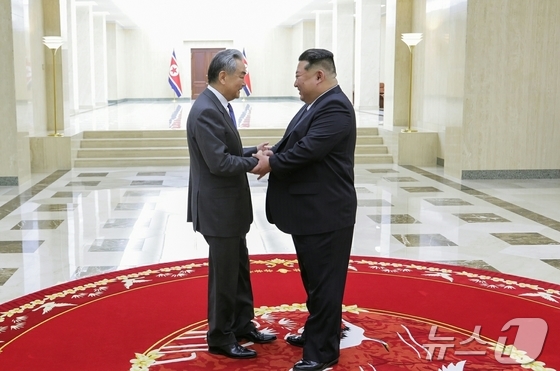
In April, North Korea announced that during a visit to Pyongyang by Wang Yi, China’s foreign minister, Kim Jong Un expressed support for the One China principle.
This marked the first time North Korean media reported that the Supreme Leader mentioned the One China principle. Given that Wang’s visit was speculated to also coordinate Xi’s potential visit to North Korea, this move could be seen as a significant endorsement of China’s stance.
Recently, circumstances supporting the likelihood of Xi’s visit to North Korea have emerged.
Reports indicate that larger aircraft from Chinese airlines have been deployed on routes to Pyongyang, and the frequency of cargo flights has increased. Observers have also noted the setup of structures in Kim Il Sung Square, typically used for welcoming foreign leaders.
Experts highlight that North Korea’s message coincides with discussions about Xi’s potential visit. They suggest that Pyongyang’s public support for China’s sensitive security issues could signify an intention to showcase strategic closeness between the two countries amid a resurgence in North Korea-China relations.
Park Won-gon, a professor of North Korean studies at Ewha Womans University, remarked that Brunson has consistently mentioned the changing role of U.S. forces in South Korea and the need to counter China in situations similar to Taiwan, yet North Korea has not reacted significantly until now. He noted that while Brunson’s use of the term dagger is a stronger expression, it aligns with the timing of discussions about Xi’s visit, suggesting that North Korea may be siding with China.
He added that in the context of the ongoing restoration and strengthening of North Korea-China relations, Pyongyang’s criticism of the U.S. strategy against China may reflect an intention to showcase its strategic alliance with Beijing.