A U.S.-South Korea interagency delegation convened its inaugural meeting to kick off discussions on building a Korean-style nuclear-powered submarine, setting the stage for further negotiations. The South Korean government is currently in talks with the U.S., focusing on a framework that involves domestic construction and American nuclear fuel supply. However, significant hurdles remain, including securing rights for uranium enrichment and reprocessing, as well as addressing international concerns about potential nuclear weapons development.
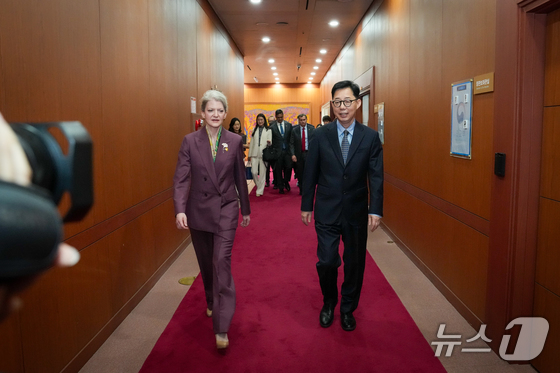
Six months after releasing their joint fact sheet, the U.S.-South Korea delegation engaged in substantive talks about nuclear submarines on Tuesday. South Korea’s Ministry of Foreign Affairs confirmed ongoing negotiations to promote domestic hull construction while planning to import fuel from the U.S. Both nations’ representatives are expected to wrap up the meeting after further deliberations on revising the U.S.-South Korea nuclear agreement.
This meeting marks the first official dialogue since the U.S.-South Korea summit in Gyeongju last October and the subsequent joint fact sheet announcement in November. As both sides exchanged views on South Korea’s Jangbogo N Project and U.S. nuclear fuel procurement strategies, the previously stagnant working-level negotiations are expected to gain momentum.
Despite progress, significant challenges persist. These include addressing verification issues with the International Atomic Energy Agency (IAEA) and alleviating international concerns about nuclear proliferation. Securing rights for uranium enrichment and reprocessing, crucial for operating nuclear submarines, remains a major obstacle. Given that these matters require extensive diplomatic negotiations and convincing various U.S. stakeholders, achieving concrete results may take considerable time.
Even with U.S. fuel supply, concerns about nuclear weapons development are not easily dismissed. For South Korea to operate nuclear submarines, it must gain the ability to use nuclear materials for military purposes, while also securing rights for enrichment and reprocessing to manage fuel replacement cycles. The current U.S.-South Korea nuclear agreement, effective until 2035, requires U.S. consent for each stage, including enrichment and reprocessing, but only covers nuclear materials used for peaceful purposes. Utilizing nuclear fuel for military applications will necessitate a separate agreement.
Experts anticipate potential disagreements between the U.S. and South Korea regarding fuel supply methods and management systems during negotiations. The U.S. maintains strict limitations on the military use of nuclear materials under its non-proliferation policy, which could complicate discussions.
For instance, while supporting Australia’s nuclear submarine program with high-enriched uranium (HEU)-based submarines that don’t require fuel replacement, the U.S. opted to supply sealed-type reactors. This approach allows the U.S. to manage the entire nuclear fuel cycle, preventing direct Australian access to the reactor’s internal fuel.
In contrast, South Korea aims to install domestically developed reactors and receive low-enriched uranium (LEU) fuel from the U.S. Even with U.S. fuel supply, South Korea would manage reactor operations, necessitating detailed coordination between the two nations.
Notably, LEU requires periodic fuel replacement. Long-term issues may arise concerning rights for uranium enrichment and spent nuclear fuel reprocessing. The international community is particularly sensitive to the possibility of extracting weapons-grade plutonium during reprocessing.
Diplomatically, convincing the U.S. of South Korea’s need for fuel cycle management within non-proliferation principles is expected to be a key negotiation point. Some analysts suggest these discussions could become a long-term issue intertwined with revising the U.S.-South Korea nuclear agreement.
Signing Separate Agreement With IAEA Also Variable… Address Predictable Opposition From China and Russia is a Must
Addressing international concerns regarding Article 14 of the Comprehensive Safeguards Agreement (CSA) within the Nuclear Non-Proliferation Treaty (NPT) framework is another priority. Nuclear materials used in submarines, given their military applications, cannot undergo routine inspections like those at conventional nuclear power plants.
Consequently, CSA Article 14 allows temporary exclusion of naval nuclear propulsion materials from inspection requirements. It mandates that the importing country prove non-diversion for weapons by signing a separate agreement with the IAEA.
Australia, which plans to acquire nuclear submarines under the AUKUS alliance, has been negotiating Article 14 agreements per CSA regulations for four years.
Moreover, concerns exist about potential international backlash over the risk of concealing or diverting nuclear materials. China and Russia have objected to CSA Article 14’s application in Australia’s case, arguing it inadequately prevents nuclear proliferation risks.
IAEA Director General Rafael Grossi commented in April on South Korea’s nuclear submarine discussions, emphasizing the need for verification mechanisms to ensure nuclear materials aren’t concealed or diverted within submarines.
Consequently, establishing a verification system that upholds non-proliferation principles while gaining international trust is likely to be a key negotiation point. If U.S. technical support is required for submarine acquisition, regulations like the International Traffic in Arms Regulations (ITAR) may also factor into future talks.
Yoo Ji-hoon, a researcher at the Korea Institute for Defense Analyses (KIDA), stated that South Korea must clearly distinguish its position from nuclear armament, consistently presenting the strategic rationale that nuclear submarines are intended to counter North Korea’s SLBMs and enhance U.S.-South Korea joint defense capabilities. Introducing nuclear submarines should contribute to regional burden-sharing while simultaneously demonstrating South Korea’s commitment to the non-proliferation regime, thereby strengthening its negotiating position in future discussions.