President Donald Trump has signaled his intention to negotiate with North Korea after addressing the situation with Iran. However, analysts widely believe that the path to actual U.S.-North Korea talks remains long and challenging due to significantly changed geopolitical circumstances and North Korea’s diplomatic stance compared to eight years ago.
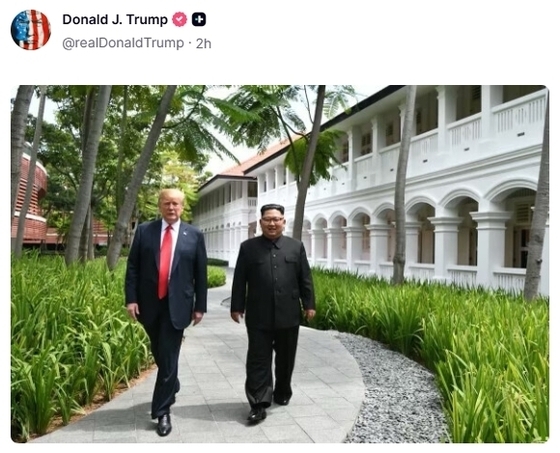
On June 14, Trump posted a photograph with Kim Jong Un on his social media platform, Truth Social. The image, taken during the U.S.-North Korea summit at the Capella Hotel on Singapore’s Sentosa Island in June 2018, shows Trump and North Korean leader Kim walking together with bright expressions.
Trump’s sudden decision to share this photo with Kim, amid crucial negotiations for a peace agreement with Iran, is interpreted as a signal of his intent to pursue diplomacy with North Korea following the resolution of the conflict with Iran.
Trump Continues to Reach out to North Korea, But Pyongyang Remains Unresponsive
As Trump prepares for a potential second term, he has been highlighting his personal relationship with Kim and expressing confidence in resuming U.S.-North Korea summit talks.
During his official inauguration day last January, Trump remarked that he knows North Korea has tremendous condo construction capabilities along its coastline, suggesting significant economic incentives could be offered if North Korea engages in dialogue. This statement is seen as a revival of his earlier proposals for economic rewards during the 2018-2019 summits.
During his visit to South Korea for the Asia-Pacific Economic Cooperation (APEC) summit last October, Trump publicly conveyed his readiness to meet Kim at any time. He also expressed interest in U.S.-North Korea talks during an April meeting with South Korean Prime Minister Kim Boo-kyum, consistently signaling his willingness to engage with North Korea.
However, North Korea has remained unresponsive to Trump’s repeated overtures. There have been no significant communications through public statements, official media, or even the informal New York Channel operated through North Korea’s United Nations (UN) mission.
Professor Park Won-gon from Ewha Womans University noted that North Korea likely perceives the limits of U.S. power in the Middle East conflict and will continue to hold out to negotiate from a position of strength. Since North Korea always seeks to gain the upper hand in negotiations, he believes the possibility of U.S.-North Korea talks remains open.
Kim: Dialogue Possible if U.S. Recognizes Nuclear Status; North Korea Continues to Raise the Bar for Talks
North Korea continues to elevate the threshold for dialogue by insisting that the U.S. must recognize it as a nuclear power.
During the 9th Workers’ Party Congress on February 9, Kim stated that if the U.S. respects our current status (as a nuclear power) and withdraws its hostile policy towards them, there would be no reason for them not to get along.
However, this condition essentially requires the U.S. to abandon its longstanding goal of North Korean denuclearization and recognize North Korea as a nuclear state, which both the U.S. and South Korea find difficult to accept. While not completely closing the door on dialogue, North Korea has shifted the starting point for negotiations from denuclearization to recognition of nuclear status, thus raising the bar for discussions.
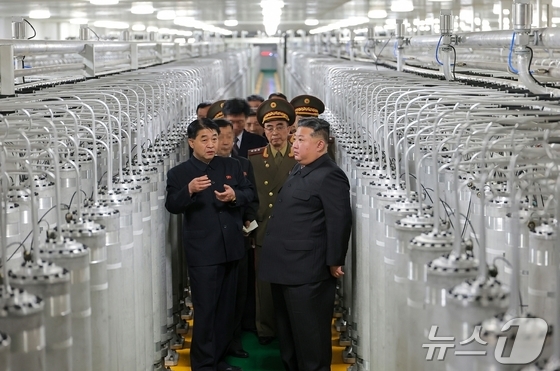
Recently, North Korea has strongly opposed the positions of the U.S., South Korea, and the European Union regarding North Korean denuclearization through foreign ministry statements. It has reacted sensitively to the international stance that North Korea cannot be recognized as a nuclear power, repeatedly emphasizing that its nuclear status is an irreversible reality.
Professor Park explained that North Korea is sending a message that denuclearization should not even be mentioned at the negotiation table. However, neither the U.S. nor even Russia and China can officially recognize North Korea as a nuclear power. North Korea’s goal might be to become a de facto nuclear power, similar to India and Pakistan, rather than seeking immediate recognition as a nuclear state.
North Korea’s need to pursue negotiations with the U.S. has diminished compared to the past. During the first U.S.-North Korea summit in 2018, North Korea aimed to exchange economic relief from international sanctions for denuclearization. Now, it is expanding military and economic cooperation with Russia and restoring relations with China, creating an environment where negotiations with the U.S. are not the only option for North Korea.
The relationship between North Korea and Russia has effectively escalated to a military alliance level due to the Ukraine war. Although China officially maintains its principle of denuclearization on the Korean Peninsula, it has shifted focus towards stabilizing relations and strengthening strategic communication following recent North Korea-China summits.
Moreover, with Trump’s term nearing its end, North Korea faces challenges in expecting long-term rewards from negotiations. North Korea has historically raised concerns about the volatility of U.S. policy during transitions of power. Unlike Trump, who seeks accomplishments before his term ends, North Korea is likely to demand more stable and permanent guarantees for its regime’s security and relief from sanctions.