On Tuesday, the Ministry of Unification and the Presidential Commission on National Water Management convened a policy forum to explore peaceful utilization and disaster prevention strategies for shared rivers between North and South Korea. The government stressed the importance of resuming cooperation, including sharing dam release information, to mitigate flood damage in border regions during the monsoon season and periods of heavy rainfall.
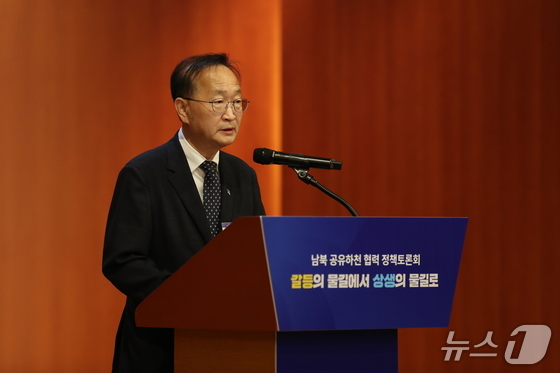
The Ministry of Unification and the National Water Management Commission jointly organized the North-South Shared River Cooperation Policy Forum: From Conflict to Coexistence at the T-Art Hall in the Taeyoung Building, Yeongdeungpo-gu, Seoul, that afternoon.
This forum was arranged in response to the onset of the flood season (June 21 to September 20), a time when climate change intensifies the risks of heavy rainfall and flooding. The focus was on discussing peaceful utilization strategies for shared waterways such as the Imjin River and the Bukhan River.
In his opening address, Vice Minister Kim Nam-jung emphasized that cooperation on shared rivers between North and South Korea is a practical and mutually beneficial endeavor directly impacting the lives of Korean Peninsula residents. It can serve as a foundation for building trust between the two sides. He expressed hope for the resumption of communication and cooperation to enable advance sharing of dam release information, thereby preventing flood damage in border areas during the rainy season and periods of heavy rainfall.
Following this, Representatives Park Jeong and Yeom Tae-young, along with First Vice Minister of Climate, Energy and Environment Kim Han-seung, delivered congratulatory remarks. Former Unification Minister Kim Yeon-chul presented the keynote address.
The forum featured presentations on topics including the current status of shared rivers and the significance of cooperation, initiatives for water and environmental collaboration in shared rivers, and the necessity for sustainable development and multilateral cooperation related to these waterways.
The comprehensive discussion, chaired by Noh Tae-ho from the National Water Management Commission, included participants from the Han River Preservation Movement Headquarters, Kyungnam University’s Institute of East Asian Studies, the Hans Seidel Foundation, and the Ministry of Unification. They deliberated on strategies for peaceful and cooperative utilization of shared rivers between North and South Korea.
Chairman Kim Jwa-gwan of the National Water Management Commission stated that cooperation on shared rivers between North and South Korea will catalyze peace on the Korean Peninsula. He committed to collaborating with the Ministry of Unification to develop effective climate and environmental cooperation plans for the peninsula while exploring new avenues for inter-Korean collaboration.
In light of recent government signals to restore inter-Korean relations, such as halting loudspeaker broadcasts and reviving civilian exchanges, this forum can be interpreted as an effort to reactivate a practical cooperation agenda. This approach focuses on resident safety and disaster response, rather than political and military issues.