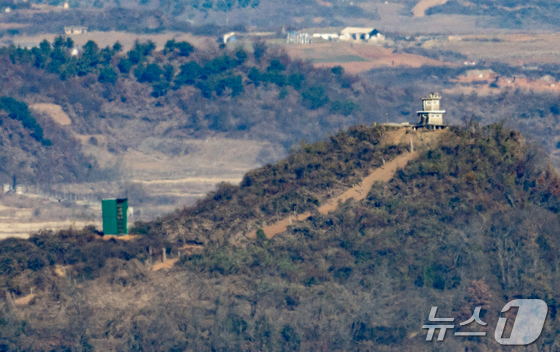
North Korea’s removal of unification-related provisions from its constitution and its designation of South Korea as a separate “state” sharing a southern border do not transform the Military Demarcation Line (MDL) or the Demilitarized Zone (DMZ) into an internationally recognized border, according to a report released Tuesday by a South Korean government-funded research institute.
The report systematically outlines the international legal arguments against North Korea’s “hostile two-state” policy and its efforts to redefine the DMZ as a national border. Analysts say it could serve as a legal reference for the South Korean government in future diplomatic disputes and international debates.
In a report published on June 30 titled International Legal Implications of North Korea’s Constitutionalization of Two States and the Borderization of the DMZ, Kim Tae-won, an associate research fellow at the Korea Institute for National Unification, argued that North Korea’s constitutional amendment in March introducing a territorial clause was a political declaration formally redefining inter-Korean relations as those between two hostile, separate states rather than a special relationship aimed at reunification. However, he said the amendment has no effect on the legal status of the Korean Armistice Agreement or the DMZ under international law.
Kim explained that while the Korean Armistice Agreement is a military accord intended to suspend hostilities rather than a peace treaty, it continues to serve as the fundamental legal framework governing the military order on the Korean Peninsula until a new peace regime is established.
He also noted that Article 62 of the Armistice Agreement stipulates that any amendment or revision requires the mutual consent of the parties and that the agreement remains in force until it is replaced by a new peace arrangement. As a result, North Korea cannot nullify the agreement or alter the legal status of the DMZ simply by amending its constitution or changing its political position.
Kim also cited Article 27 of the Vienna Convention on the Law of Treaties, which states that a country may not invoke its domestic law as justification for failing to fulfill its treaty obligations. He argued that North Korea’s constitutional revisions concerning territory and borders amount only to domestic legal provisions or political claims and therefore cannot unilaterally alter the international legal status of the Armistice Agreement or the DMZ.
He further argued that even though North Korea has effectively abandoned the inter-Korean military agreement signed on Sept. 19, 2018, doing so affects only the operating environment of the armistice system and does not terminate or automatically amend the Armistice Agreement itself.
Kim characterized North Korea’s constitutional amendment and its recent construction of barbed-wire fences, anti-tank barriers and minefields in and around the DMZ as part of a broader “borderization strategy.” Rather than creating a new international border, he said, Pyongyang is attempting to give the MDL and DMZ the functional characteristics of a national border, weakening the DMZ’s role as a buffer zone under the armistice and transforming it into a fortified border defense area.
The analysis aligns with the South Korean government’s recent position that North Korea’s construction activities inside the DMZ violate the Armistice Agreement. On the 22nd, the Ministry of National Defense described the installation of fences and barriers as an acceleration of North Korea’s effort to redefine the MDL as an international border under its “hostile two-state” doctrine and called the actions a clear violation of the Armistice Agreement.
The United Nations Command, however, has said that defensive construction or fortification activities do not automatically constitute violations of the Armistice Agreement and should be assessed on a case-by-case basis. Kim acknowledged the differing views but argued that North Korea’s repeated fortification efforts and installation of physical barriers ultimately undermine the DMZ’s buffer function and could become grounds for discussions of state responsibility under international law.
Kim recommended that the South Korean government continue documenting North Korea’s borderization rhetoric and construction activities to build international support for legal non-recognition. He also urged Seoul to consistently raise the issue at international forums, including the U.N. General Assembly, the U.N. Security Council and the U.N. Human Rights Council. As a longer-term option, he suggested considering a request through the U.N. General Assembly for an advisory opinion from the International Court of Justice.
Because the Korea Institute for National Unification is a government-funded think tank that supports Seoul’s North Korea and reunification policy, the report is viewed as more than an academic assessment. It also outlines a potential legal framework for the government’s response to North Korea’s constitutional “two-state” doctrine and its efforts to redefine the DMZ as a national border.
With North Korea continuing to build fences and barriers north of the MDL and the South Korean government characterizing those actions as violations of the Armistice Agreement, observers say the report’s legal reasoning could play a significant role in Seoul’s future diplomatic and legal efforts on the international stage.