

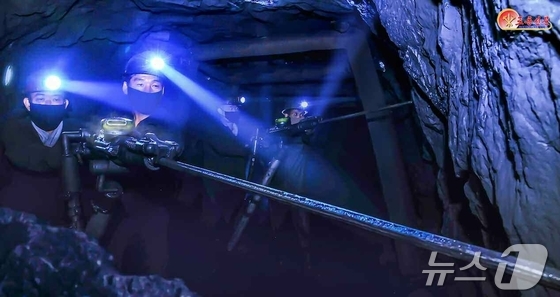
North Korea is exploiting its relationships with China and Russia to circumvent the United Nations (UN) sanctions while expanding its coal and mineral exports. A report released on Thursday indicates that this process has entrenched a system where forced labor and export revenues directly contribute to the development of nuclear weapons and missiles.
In a recently published report titled, North Korean Minerals Navigating Sanctions, the Citizens’ Alliance for North Korean Human Rights (NKHR) analyzed that while North Korea’s mineral exports slowed during the COVID-19 pandemic, they quickly rebounded following increased military cooperation with Russia and strengthened ties with China.
The report reveals that ship activity detected at North Korea’s five major ports skyrocketed from 783 instances in 2019 to 3,756 in 2025, a nearly fivefold increase. Over 3,000 of these occurrences were confirmed at Nampo Port, North Korea’s primary terminal for oil and coal cargo. Notably, the report highlighted a shift from third-country vessels to Chinese-flagged ships, signaling China’s deepening direct involvement in these operations.
The NKHR report emphasizes that North Korea’s mineral production heavily relies on forced labor, exploiting soldiers, political prisoners, unrepatriated prisoners of war, and their descendants. The revenue generated from coal and mineral exports through this forced labor is channeled not only into nuclear and missile development but also into procuring military supplies and funding state security agencies.
NKHR’s analysis indicates that even after the UN Security Council’s 2017 sanctions resolution against North Korea, the country’s Ministry of Defense effectively monopolizes coal exports. This structure, where the military controls coal production and exports, was solidified following the purge of Jang Song-thaek, a key figure in the early days of Kim Jong Un’s regime, when existing foreign currency earning organizations were absorbed by the Defense Ministry.
The report also notes that North Korea’s sanctions evasion tactics have grown increasingly sophisticated. These include systematically blocking Automatic Identification System (AIS) signals on coal-carrying ships, conducting ship-to-ship transfers in international waters, falsifying shipping registrations, disguising exports as Russian in origin, and utilizing secret accounts in Chinese banks for payments. Moreover, the report suggests that the conclusion of the UN Security Council’s North Korea sanctions expert panel activities in 2024, coupled with expanded North Korea-Russia military cooperation and North Korea-China collaboration, has further bolstered the regime’s sanctions evasion infrastructure.
NKHR, in collaboration with the British investigative agency Data Desk, has tracked vessels moving between North Korea, China, and Russia since 2023. They have compiled a database of 47 ships, including 27 sanctioned vessels and 20 high-risk North Korean bulk carriers not yet under sanctions.
The report urges the international community to take several actions: intensify monitoring of Chinese and Russian ports and financial networks, designate additional vessels for sanctions, implement import restrictions on minerals produced through forced labor, and expand Magnitsky-style human rights sanctions targeting individuals and entities involved in severe human rights violations or corruption.