

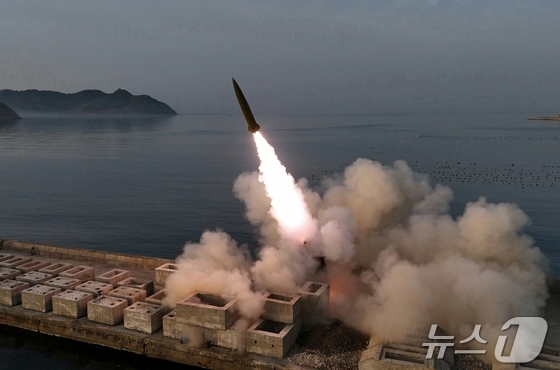
South Korea’s Ministry of Unification said it was not placing significant meaning on North Korea’s decision not to report the launch. A ministry official said, “There have already been multiple cases in which North Korean state media did not report missile launches,” adding, “We do not consider this a special situation and will continue monitoring without making assumptions about the reasons behind the lack of coverage.”
However, the latest launch differs significantly from North Korea’s major missile and artillery tests disclosed this year. After conducting tests involving a hypersonic missile, upgraded large-caliber multiple rocket launchers, a 600mm super-large precision-guided rocket system, the “Hwasong-11Ra” type missile and other new weapons systems, North Korea released detailed reports featuring photos, the attendance of leader Kim Jong Un, weapon names, test objectives and strike results.
The contrast is especially notable compared with the previous launch on June 25. At the time, North Korea conducted tests involving an upgraded 240mm multiple rocket launcher, tactical ballistic missiles and extended-range ammunition for 155mm self-propelled artillery under Kim Jong Un’s supervision. The following day, state media widely reported the tests with photos. Kim described maintaining “the enemy in constant anxiety and fear” as an important aspect of exercising war deterrence capabilities, openly emphasizing North Korea’s strike capabilities against South Korea.
In contrast, North Korea only launched one SRBM this time and disclosed no information regarding Kim Jong Un’s attendance, the weapon type, test purpose or results. Experts offered different interpretations of the silence.
“Possible failure to achieve desired test results”… Analysts focus on single launch
Hong Min, a senior researcher at the Korea Institute for National Unification, said the possibility that the test did not achieve the intended outcome should be considered.
“Recently, North Korea has actively publicized demonstration launches in response to South Korea-U.S. military exercises,” Hong said. “A method of leaving the other side to interpret the launch without announcing it does not align with its recent pattern of behavior.”
He particularly focused on the fact that only one missile was launched.
“A single launch is generally associated with testing purposes, while demonstrations of military force typically involve two or more launches to show the ability to fire multiple weapons simultaneously,” Hong said. “There is a strong possibility that North Korea tested a new weapons system but did not achieve the results it wanted.”
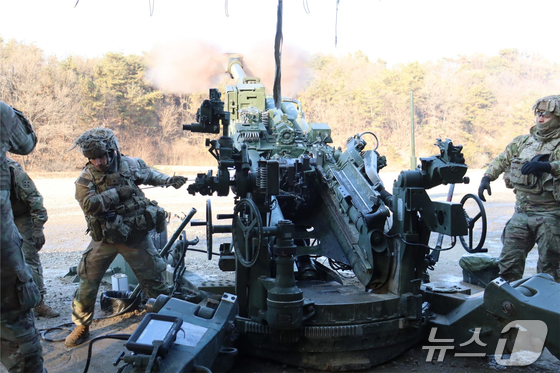
Others interpreted the launch as a limited warning rather than a major escalation, noting that it occurred ahead of this month’s UFS exercise, scheduled for Aug. 18-21.
North Korea has long described the South Korea-U.S. joint military exercise as a “preparation for a northward invasion” and has responded with missile launches and other military actions. In 2023, North Korea launched a second military reconnaissance satellite and short-range ballistic missiles during the UFS period while beginning a “whole-army command training exercise” simulating an all-out war.
Yang Moo-jin, a professor emeritus at the University of North Korean Studies, said, “North Korea’s intention is to oppose UFS,” adding, “The possibility of additional missile launches during the exercise period is high, and North Korea may release related reports in batches during or after the exercise.”
He added, “Given that it stopped at a single SRBM launch, this can be viewed as a limited show of force aimed at controlling tensions rather than sharply escalating them.”
Launch comes one day after ‘peaceful coexistence initiative’ announcement, but no separate message from Pyongyang
The launch also drew attention because it occurred one day after South Korea’s Unification Minister Jeong Dong-young announced the government’s “Korean Peninsula Peaceful Coexistence Development Initiative” during a presidential briefing.
Jeong said the government aims to transform hostile relations between the two Koreas into a peaceful relationship between two states that pursue eventual unification, while promoting four-party dialogue involving South Korea, North Korea, the United States and China and discussions on a peace regime.
South Korean President Lee Jae-myung acknowledged that efforts by the Ministry of Unification could feel like “a voice without an echo,” but urged officials to “continue pursuing policies for peace and coexistence with patience.” He also called for careful consideration, saying, “Whether acting based on our goodwill truly contributes positively to peace and stability on the Korean Peninsula must be carefully assessed.”
Experts cautioned that the timing alone does not prove the launch was a direct response to the government’s peace initiative. Since North Korea neither promoted the launch nor issued a separate statement toward South Korea, interpreting it as a complete rejection of dialogue would be premature.
However, with the ballistic missile launch occurring immediately after Seoul reaffirmed its commitment to peaceful coexistence, the South Korean government faces a more difficult challenge in seeking a breakthrough in dialogue by encouraging a response from Pyongyang.