

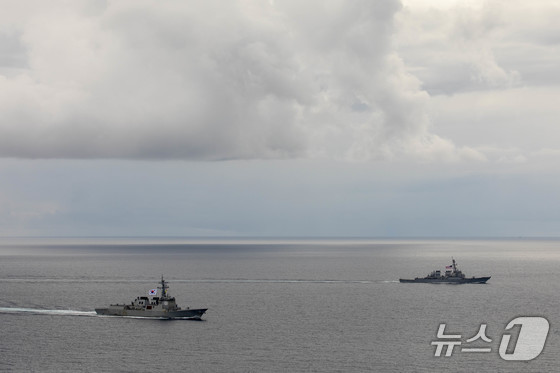
On Monday, South Korea, the U.S., and Japan launched their regular multi-domain joint exercise, Freedom Edge. North Korea’s unwavering hardline stance against these trilateral drills raises concerns about potential retaliatory actions, including possible ballistic missile launches.
The Joint Chiefs of Staff reported that the five-day Freedom Edge 2026 exercise will take place in international waters southeast of Jeju Island from September 7 to 11.
Officials described the drill as a defensive, annual exercise aimed at enhancing deterrence and response capabilities against North Korean nuclear and missile threats while upholding international laws and norms to safeguard regional peace and stability.
Key naval and air assets from the three nations will participate. A joint training control unit will oversee operations, focusing on strengthening collaborative capabilities across maritime, air, and cyber domains.
Since agreeing to conduct multi-domain training at their 2023 summit, the three countries have held Freedom Edge exercises three times since 2024. Last year’s drills included maritime missile defense, anti-submarine warfare, air operations, air defense, counter-piracy, and cyber defense components.
Notably, 2025 marked the first Freedom Edge without a U.S. aircraft carrier. Analysts attribute this to the concentration of U.S. carrier forces in the Middle East following February’s U.S.-Israeli strikes on Iran, as well as President Donald Trump’s recent decision to scale back U.S.-South Korea joint exercises as part of his North Korea policy. Similar carrier absence is expected this year.
Despite this, experts warn of a high likelihood of North Korean retaliation. On August 31, Pyongyang’s Foreign Ministry spokesperson claimed that Freedom Edge 2026 further destabilizes regional security, citing an increasingly aggressive U.S. nuclear posture and Japan’s rearmament within the U.S.-Japan-South Korea military cooperation framework.
The statement emphasized that its policy of maximum strength against America’s persistent hostility remains absolutely unchanged.
Even after President Trump’s gestures toward dialogue and reduced Ulchi Freedom Shield (UFS) exercises, North Korea fired approximately ten short-range ballistic missiles into the East Sea on August 20, just before UFS concluded.
Pyongyang has also condemned the U.S.-led Rim of the Pacific Exercise (RIMPAC) naval exercise, which included South Korean and Japanese forces, as a war rehearsal for America’s Asia-Pacific strategy. It criticized the trilateral Joint Chiefs’ meeting that planned Freedom Edge as the root cause of instability in the Korean Peninsula and Asia-Pacific region.
Recent North Korean protests against Japan’s relaxed arms export policies and Tomahawk cruise missile tests have heightened tensions. Observers are closely monitoring for any escalation in rhetoric or military provocations from Pyongyang during the Freedom Edge exercise.