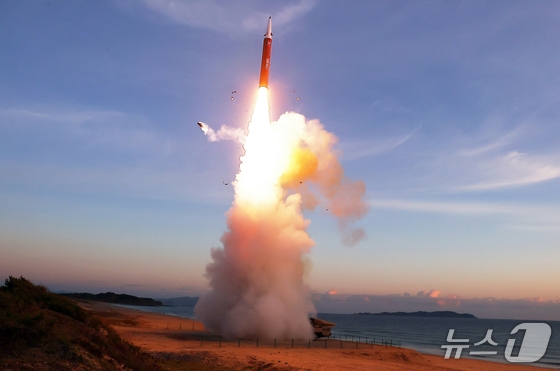
Military authorities have assessed that they can adequately counter North Korea’s recently launched hypersonic medium-range ballistic missile (MRBM). This directly refutes North Korea’s claim that it can evade South Korean and Japanese missile defense systems using irregular flight trajectories.
On the afternoon of October 4, the Ministry of National Defense issued a statement on North Korea’s ballistic missile launch, saying that its military has closely monitored North Korea’s recent series of missile launches from the preparation stage, promptly detecting and tracking the missiles post-launch and accurately identifying their origin.
The statement emphasized that the U.S. and South Korea maintain a strong combined defense posture, and it assesses that the defense assets can sufficiently detect and intercept the missiles recently launched by North Korea.
Previously, at approximately 6:30 a.m. (KST) on October 3, North Korea fired a medium-range strategic missile into the East Sea from the Wonsan area in Gangwon Province.
The following day, North Korea’s state-run Rodong Sinmun newspaper reported that Kim Jong Un, the General Secretary of the Workers’ Party, personally observed the launch exercise, demonstrating the operational capability of their hypersonic medium-range ballistic missile.
Experts believe this missile incorporates a solid-fuel propulsion system from the Hwasong-16 and a conical warhead. The flight path disclosed by North Korea exhibited a wave-like trajectory, with the missile gaining altitude during its descent phase.
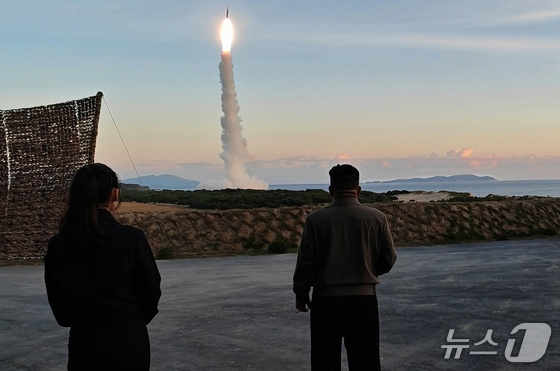
North Korea claimed the missile struck a target approximately 1,000 kilometers (about 621 miles) away in the East Sea. However, South Korea’s Joint Chiefs of Staff tracked the missile traveling over 700 kilometers (about 435 miles), while Japan’s Defense Ministry estimated its flight at about 680 kilometers (about 423 miles).
Kim Yo Jong, Deputy Director of the Workers’ Party of Korea, used this discrepancy to argue that South Korea and Japan failed to track the missile throughout its entire flight.
In a statement released on the launch day, she asserted that whenever they employed the wave-like flight trajectory, the adversaries lost track of the target after the initial jump.
Kim further remarked that it’s worth recalling our announcements about the ability to alter flight paths at low altitudes and the integration of artificial intelligence. In essence, this means there’s virtually no way to intercept this strike.
Hypersonic missiles, capable of gliding and re-boosting, fly at lower altitudes than conventional ballistic missiles and can alter direction and altitude, making them challenging for ground-based radar to detect, track, and intercept.
North Korea’s emphasis on wave-like flight trajectories and low-altitude maneuverability in this launch is seen as an attempt to showcase its ability to penetrate existing missile defense systems.
The Ministry of National Defense also stated that North Korea’s ballistic missile launch is a grave violation of United Nations (UN) Security Council resolutions. It urges North Korea to immediately cease actions that escalate tensions on the Korean Peninsula and to engage in efforts to establish peace in the region.