As the U.S. focuses on the Middle East crisis, evidence suggests that some U.S. Forces Korea (USFK) assets have been relocated to the region. This development is seen as a test case for America’s strategic flexibility policy regarding overseas-stationed troops, according to observations made on Monday.
The U.S. is moving weapons from various locations, including those assigned to USFK, to either the U.S. mainland or the Middle East in preparation for a prolonged conflict. The extent of U.S.-South Korea communication during this process and how both nations address any potential capability gaps resulting from rotational deployments will likely reveal the contours of this strategic flexibility approach.
U.S. Transport Aircraft Congregate at Osan Air Base Before Departure… Potential Removal of Patriot Systems
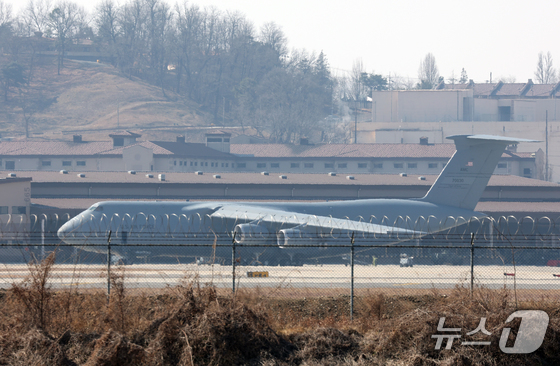
According to real-time flight tracking websites, C-5 and C-17 transport aircraft previously identified at Osan Air Base in Gyeonggi Province have mostly departed South Korea, arriving either in the continental United States or the Middle East. The surge in these departures began after the Iranian attacks on February 28. These transport aircraft are typically used to move Patriot batteries or Terminal High Altitude Area Defense (THAAD) systems.
While both the U.S. and South Korea are refraining from direct comments on the movement of USFK assets and equipment, they maintain that a robust combined defense posture ensures no compromise to peninsula defense. However, observations of Patriot batteries relocating from other U.S. bases to Osan, along with persistent rumors about the potential deployment of Army Tactical Missile Systems (ATACMS), Multiple Launch Rocket Systems (MLRS), and THAAD, suggest that force movements are indeed occurring.
This is likely a preemptive measure by the U.S. to consolidate globally dispersed missile stockpiles in preparation for a potential long-term conflict, as the Iran war shows signs of expanding across the Middle East.
On March 8, Israel initiated large-scale airstrikes on targets in Tehran and other Iranian locations. Iran retaliated with drone and missile attacks not only on the United Arab Emirates (UAE) and Saudi Arabia but also on Kuwait and Bahrain. These neighboring countries have warned of potential retaliation if attacks on their critical energy infrastructure continue, indicating that the Middle East crisis shows no signs of abating.
USFK Strategic Flexibility Potentially Expanding to Middle East… Addressing Concerns Over Force Capability Gaps
Some analysts view the USFK force movements as part of the alliance modernization and strategic flexibility of overseas-stationed forces, initiatives pursued by the Trump administration. This redeployment to the Middle East is interpreted by some as a signal of USFK’s expanding role as a rapid response force, capable of freely moving troops and equipment during international conflicts.
The strategic flexibility of USFK typically involves South Korea taking the lead in conventional peninsula defense, while allowing U.S. forces to deploy USFK assets for strategic matters in the Indo-Pacific region, such as North Korean nuclear deterrence or potential Chinese aggression against Taiwan.
This aligns with the 2006 U.S.-South Korea agreement respecting U.S. strategic flexibility while ensuring South Korea’s non-involvement in Northeast Asian conflicts without its consent when the U.S. exercises this flexibility. This principle was reaffirmed in last year’s U.S.-South Korea summit joint fact sheet.
However, the current Middle East crisis has led some to argue that USFK’s potential involvement in conflicts has effectively expanded beyond the Indo-Pacific to a global scale. This could be viewed as the first application of strategic flexibility following the announcement of the new U.S. National Defense Strategy (NDS) earlier this year.
Andrew Yeo, the Korea Chair at the Brookings Institution, highlighted in his October report, Modernizing the U.S.-South Korea Alliance under Presidents Donald Trump and Lee Jae Myung, that the movement of U.S. Patriot and THAAD batteries from the Korean Peninsula to the Middle East and back represents a prime example of working-level strategic flexibility between the U.S. and South Korea.
As the Iran conflict shows potential for prolongation, concerns are being raised about possible security gaps on the Korean Peninsula due to USFK force redeployments. For instance, the removal of THAAD, which currently plays a crucial role in high-altitude defense within the Korean Air and Missile Defense (KAMD) system, could create vulnerabilities in the air defense network if relocated to the Middle East or the U.S. mainland.
Um Hyo-sik, Director of Defense Industry and Security at the Korea Defense and Security Forum, noted that South Korea’s indigenous THAAD equivalent, the Long-range Surface-to-Air Missile (L-SAM), is not yet operational. He suggested that if THAAD were to be removed from the peninsula, alternative methods such as launching SM-3 missiles from destroyers would need to be considered, though these couldn’t fully replace THAAD’s capabilities.
However, some analysts urge caution, pointing out that the Middle East doesn’t align with the Western Hemisphere (Americas) First principle outlined in the National Defense Strategy (NDS) and National Security Strategy (NSS). They also emphasize that the current USFK asset reallocation appears to be a temporary measure rather than a permanent restructuring, suggesting the need for continued observation of these developments.
Min Jung-hoon, a professor at the American Studies Department of the Korea National Diplomatic Academy, stated that the deployment of USFK assets to the Middle East conflict seems to be a temporary measure for immediate response. Considering factors like China, the U.S. is likely to retain core capabilities for North Korean defense. He added that it may be premature to view this as strategic flexibility aimed at restructuring overseas forces to align with U.S. priorities and increase efficiency.