

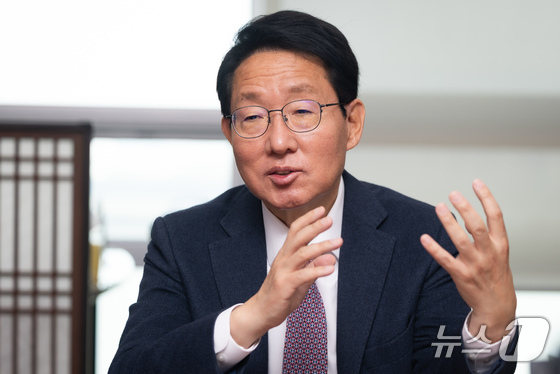
Kim Sang-hoon, a four-term member of the National Assembly from the People Power Party (representing Daegu Seo-gu) and chairman of the Special Committee on U.S. Investments, predicted that if the U.S. Investment Special Act passes, President Donald Trump would not implement tariff policies that burden South Korea. He emphasized that the opposition party made this decision for the national interest and the welfare of the people.
In an interview with News1 on Monday at the National Assembly member’s office, Kim stated that the fact that the U.S. has not published a gazette regarding tariff reimposition and has waited indicates their expectations for the special act.
He noted that the passage of the special act through the committee reflects his unwavering belief in the need for a bipartisan legislative process. Kim explained that considering the economy and national interest, there was mutual understanding between the ruling and opposition parties that it should be processed within the scheduled time.
Kim also remarked that even in the face of a national crisis, the ruling party pushed through the three laws of judicial destruction, escalating the confrontation between parties. However, if the processing of the special act is delayed, it could lead to a decline in national credibility and uncontrollable investment uncertainty for companies. Therefore, it made this decision solely for the national interest and the welfare of the people.
Regarding the upcoming visit of members of the Korea-U.S. Congressional Alliance to the U.S. on March 28, he said that this visit serves as an opportunity to explain to the U.S. that the National Assembly has reached an agreement with a win-win mindset. He assessed that if the special act had not passed, it would have been a very uncomfortable visit, but now they can breathe a sigh of relief.
Previously, the special committee held a plenary session the day before and passed the Special Act for Strategic Investment Management between Korea and the U.S. (U.S. Investment Special Act) through a bipartisan agreement. The special act is expected to be processed at the plenary session scheduled for March 12.
The special act aims to establish a new Korea-U.S. Strategic Investment Corporation and mandates that the National Assembly receive prior reports from the government regarding investment matters. Additionally, it stipulates that investment information, except for national security and corporate management secrets, will generally be made public. It also includes provisions for establishing a Risk Management Committee to manage investment risks.
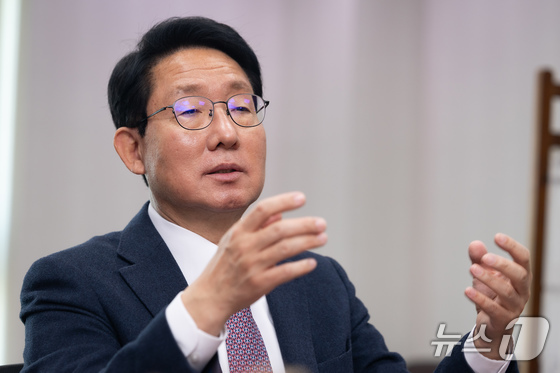
Kim emphasized that the most significant difference from the government’s proposal is securing the National Assembly’s oversight authority and transparency in personnel matters. He explained that while the government requested discretionary powers for regular reporting at least once a year to facilitate swift investments, they chose a compromise that mandates prior reporting to enhance both democratic control and procedural efficiency.
He also addressed personnel transparency, stating that to prevent parachute appointments, the president of the investment corporation will be strictly limited to individuals with over ten years of experience in strategic industries or finance and investment.
Regarding the impact of the special act on domestic companies, he predicted that the uncertainty of tariff fluctuations will decrease, enhancing the management stability of companies and reducing the risk of additional tariff increases. He added that by utilizing the provision in the special act that states efforts should be made to recommend and consult with the U.S. to select Korean companies or Koreans whenever possible, it can lead domestic companies to enter the U.S. market.
He continued that the special act targets strategic industries for investment. Kim expressed hope that, similar to the so-called Chip 4 Alliance in the semiconductor sector (the U.S., South Korea, Japan, and Taiwan), the two countries can strengthen supply chain blocks in next-generation technologies like artificial intelligence (AI) and quantum computing, collaborating to enhance global technology standards and market share.
He acknowledged concerns that the special act serves as a measure for a few large corporations such as Samsung Electronics, SK Hynix, and Hyundai Motor. Kim stated that it’s true that global companies leading investments in the U.S. will directly benefit. However, if Samsung builds an additional semiconductor plant in the U.S., domestic materials and components companies that have collaborated for decades will also gain access to opportunities in the global market.
Nevertheless, regarding worries that expanding investments in the U.S. could lead to the hollowing out of domestic industries, he remarked that this was a concern it contemplated during the legislative process. He added that the government should prepare policy supplements, and the National Assembly must consider subsequent legislation to strengthen the domestic industrial base and facilitate the return of overseas profits to domestic investments.
△ Born in Daegu in 1963 △ Graduated from the College of Law at Yeungnam University △ Passed the 33rd National Administrative Examination △ Served as Director of the Economic and Trade Bureau of Daegu Metropolitan City △ Chairman of the Local Government Committee of the Liberty Korea Party △ Member of the Emergency Response Committee of the People Power Party △ Chairman of the Planning and Finance Committee of the 21st National Assembly △ Chairman of the Special Committee on Livelihood and Economic Stability of the People Power Party △ Policy Chair of the People Power Party △ Chairman of the Special Committee on U.S. Investments in the National Assembly △ Member of the 19th, 20th, 21st, and 22nd National Assemblies