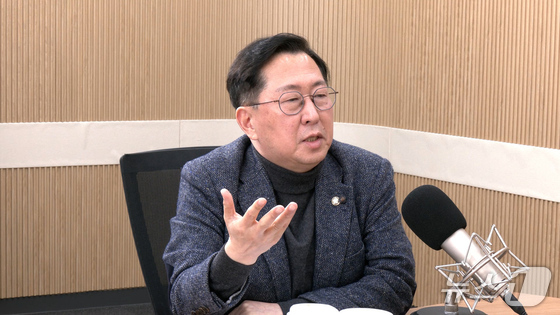
▷Lee Ho-seung: This is Lee Ho-seung of News1TV Fact & View. We’re starting our March 10 broadcast. After Ali Khamenei’s death, the Middle East stands at a crossroads of revenge and escalation. We’ll examine whether Donald Trump-style peace through strength will work and check on the turbulent global war situation. Joining us in the studio is Representative Yoo Yong-won of the People Power Party. Hello. I’d like to ask about Iran first, but before that, you visited Ukraine in February, right? How’s the war situation there? Is it still ongoing?
▶Yoo Yong-won: Actually, it seems to have gotten worse in some ways. I went there at the end of February last year, February 24 being the day the Ukraine war broke out. So I went for the 3rd anniversary last year and the 4th anniversary this year. President Trump really pushed for peace negotiations, but since it’s become a territorial battle, both sides, especially Russia, have intensified their offensive. As a result, Russia has improved its production capacity for drones, so they’re launching more combined drone and missile attacks than last year. When I was there for 2 nights and 3 days in Kyiv, there were two air raid alerts, and while there were no deaths, there were injuries. Just before I arrived, there was a large-scale attack that resulted in multiple casualties. Looking at the situation now, Vladimir Putin’s goal is to occupy 100% of the Donbas region in the east, and they’ve currently occupied about 90%.
▷Lee Ho-seung: Has Kursk almost fallen as well?
▶Yoo Yong-won: Yes, Kursk has been completely recovered. The Russian military’s goal is to occupy 100% of the Donbas region by September. In that context, the Russian offensive continues, and overall, the situation seems to have worsened.
▷Lee Ho-seung: North Korea keeps supplying weapons to Russia, but I wonder if Ukraine is having trouble with supplies due to the Iran war.
▶Yoo Yong-won: Yes, as reported in foreign media, from Ukraine’s perspective, the Patriot is a key missile for defending against combined drone and missile attacks. But now with the Middle East conflict, the U.S. is pulling them all out, even reportedly from the U.S. Forces Korea (USFK). So relatively, interest in Ukraine has decreased. Recent foreign reports say Ukraine is offering drone interception data in exchange for Patriot support. Overall, Ukraine’s position has become more difficult.
▷Lee Ho-seung: Wouldn’t it be more advantageous for the U.S. to exchange Patriots for interceptor drones? Because of their cost-effectiveness.
▶Yoo Yong-won: Of course, in terms of cost-effectiveness, and moreover, when I visited a drone company in Ukraine this time, they had such interceptor drones. These drones directly collide with incoming drones to neutralize them. The interceptor drone I saw at the company had a top speed of about 300 km/h (about 186 mph), and importantly, it cost 1,500 USD. That’s just over 2 million KRW (about 1,360 USD) in our currency. It’s not even 10 million KRW (6,800 USD). So it’s very cheap. With this level of cost-effectiveness, especially from the U.S. perspective, it could be a good card to play.
▷Lee Ho-seung: That’s the Sting, right?
▶Yoo Yong-won: It’s the Sting, but what I saw was different, though similar.
▷Lee Ho-seung: So there’s more than one type of interceptor drone.
▶Yoo Yong-won: There are several drone companies in Ukraine, so what I saw was different, but the Sting is a slightly more expensive type of drone. Ukraine has really developed these through combat experience. What was really impressive was the three-dimensional (3D) printers – over 1,200 were operating simultaneously. They were using 3D printers to make the bodies of the interceptor drones. So I thought, not just the U.S., but our country’s Defense Ministry and Defense Acquisition Program Administration should go see this and get inspired.
▷Lee Ho-seung: Has our country not developed anything like interceptor drones yet?
▶Yoo Yong-won: Some domestic companies have developed artificial intelligence (AI) interceptor drones. But they’re still quite expensive. So I think we need to learn from Ukraine’s know-how in this area.
▷Lee Ho-seung: Is mass production not set up yet?
▶Yoo Yong-won: Not yet. They’re expensive. And there are other factors too.
▷Lee Ho-seung: I see. Anyway, as you mentioned, the peace negotiations have stalled due to the U.S.-Iran war. It doesn’t seem like negotiations will resume or peace will be achieved easily because of this conflict.
▶Yoo Yong-won: Originally, we expected it might happen by June if things went well, but now it looks like it will be delayed even further. From what I felt in Ukraine, it would be fortunate if it happens by fall, or even by the end of the year.
▷Lee Ho-seung: It could drag on even longer.
▶Yoo Yong-won: So, at the earliest, we’re looking at this fall or the end of the year.
▷Lee Ho-seung: I see. As you mentioned, drones have completely changed the landscape of modern warfare. We talked about the Sting, and in this U.S.-Iran war, it’s said that Cheongung-II intercepted over 90% of Iran’s missiles and drones. Is this factual?
▶Yoo Yong-won: Yes, initially it was reported that a combination of Cheongung-II, Patriot, and other systems in the United Arab Emirates (UAE), including Russian and Iranian interceptor missiles, as well as the Terminal High Altitude Area Defense (THAAD), achieved an overall interception rate of over 90%. But when I looked into it more closely, I found that Cheongung-II alone achieved a 96% interception rate, which I released to the media. Digging deeper, as of early March, out of the Iranian missiles attacking the UAE – both ballistic and cruise missiles – 161 ballistic missiles were intercepted by a combination of Cheongung-II and Patriot PAC-3, achieving nearly 100% interception. For cruise missiles, 8 were launched, and Cheongung-II was solely responsible for intercepting them. It intercepted all 8, achieving 100%. Of course, cruise missiles are easier to intercept than ballistic missiles because they’re slower. Nevertheless, achieving 100% interception in actual combat is significant. This is meaningful because while the Patriot Advanced Capability-3 Cost Reduction Initiative (PAC-3 CRI) has an interception altitude of about 20 km (about 12 miles), and the latest missile segment enhancement (MSE) version can reach 30 km (about 18 miles), our Cheongung-II is much more cost-effective. A single Patriot missile costs over 60 billion KRW (about 41 million USD), while our Cheongung-II costs 15-25 billion KRW (about 10.2-17 million USD). So it’s about 4 times more cost-effective. Moreover, the Patriot’s 90% hit rate wasn’t achieved from the start. It took over 20 years of combat use and improvements to reach that level. Our Cheongung-II, in its first combat deployment, has achieved at least a 90% hit rate, which is remarkable.
▷Lee Ho-seung: That’s incredibly fast progress, catching up to 30 years of development in just a few years.
▶Yoo Yong-won: Yes, it demonstrated this performance in actual combat without the trial and error period, and at a much lower cost. While war should never happen, just as Poland’s defense industry boomed due to the Ukraine war, making K-defense products popular, the Cheongung-II could become a star weapon in this Middle East conflict against Iran, much like how the Patriot became famous in the Gulf War. In fact, the UAE urgently requested more Cheongung-II systems, sending a C-17 transport plane to Korea. While not officially confirmed, media reports suggest they took about 30 missiles.
▷Lee Ho-seung: Korea also has many Cheongung systems deployed currently, right?
▶Yoo Yong-won: Yes, we have several batteries deployed. There are two types of Cheongung: Cheongung-I primarily for shooting down aircraft, and Cheongung-II mainly for missile interception, though it can also handle drones. However, at over 15 billion KRW (about 10.2 million USD) per missile, it’s a bit expensive for drone interception. Due to the increasing North Korean missile threat, the Korean military is increasing the number of Cheongung-II systems beyond the original plan. For security reasons, I can’t disclose the exact numbers, but we are significantly increasing the quantity. Middle Eastern countries, especially the UAE, are already requesting more Cheongung-II systems urgently, and this demand is likely to continue. However, it might be difficult to meet all these demands immediately, as our own military also needs to introduce them quickly.
▷Lee Ho-seung: The ones sent to the UAE were originally meant for our military, right? They were sent ahead of schedule.
▶Yoo Yong-won: While not officially confirmed, that’s likely the case. We have a separate production plan for export versions, but these were probably being produced alongside those for the Korean military. There have been similar cases with exports to Poland in the past. So it’s a possibility.
▷Lee Ho-seung: Cheongung-II intercepts at around 15 km (about 49,212 feet) altitude, right? Do we have air defense systems in place below that?
▶Yoo Yong-won: For low altitudes, we have the Biho, which is a vehicle mounted with 30mm guns, and there’s also the Biho hybrid that includes Singung portable anti-aircraft missiles. The Biho hybrid is also in demand in the Middle East region, with its importance highlighted by this Middle East conflict. Some countries are reportedly considering its introduction. Besides that, we have portable anti-aircraft missiles like Singung, and the Cheonho, which is a wheeled armored vehicle with a 30mm gun. So we have a multi-layered defense system. We’ve almost completed the development of L-SAM, which intercepts at 40-60 km (about 131,234-196,850 feet) altitude, so we’re establishing a multi-layered defense system. However, with the increasing drone threat, there are still some questions about our capabilities in that area.
▷Lee Ho-seung: I’ve heard that Biho or Biho hybrid systems are sufficient for drone interception. Is that possible?
▶Yoo Yong-won: There are various means to intercept drones. There’s the so-called hard kill method of physically destroying them, whether with guns, and even shotguns are being reconsidered lately, or using interceptor drones to collide and destroy them. The downside of hard kill methods is the falling debris.
▷Lee Ho-seung: Is that why we couldn’t intercept the North Korean drones that entered a few years ago?
▶Yoo Yong-won: That was part of the reason. Even though Cobra attack helicopters, Apaches, and even F-15K fighters were scrambled, they couldn’t fire their guns. The debris from shooting them down could cause damage, and we’re sensitive about firing shells that could fall on our apartment buildings. That’s why proper firing wasn’t really possible. As an alternative, soft kill methods are being considered. The most representative of these is jamming – disabling drones through electronic interference. Another method that might seem primitive but is gaining attention again is capturing drones with nets. This doesn’t cause physical damage. Ukraine is currently using this method. Jamming technology is developing rapidly. As a result, drones are being developed that are immune to jamming, using things like fiber optics, and ultimately, AI drones. AI drones don’t need external commands and can operate autonomously, making them immune to interference. So, like the constant evolution of spears and shields, we’ll ultimately need to use a combination of hard kill and soft kill methods to counter drones. Realistically, we’ve reached the conclusion that we need to employ various countermeasures. In terms of cost-effective solutions, laser weapons are actually the most representative. The firing cost for laser weapons is minimal, about 1 USD per shot, and they can disable targets instantly. Currently, the output is low, so it takes some time to disable a target, but with increased power, they could neutralize targets with just a brief exposure. The most threatening scenario is swarm drones – if dozens or hundreds of drones attack simultaneously, guns or lasers have limitations as they can only target one at a time. So we also need weapons that can neutralize drones over a relatively wide area, like High-Power Microwave (HPM) weapons. We’re currently developing HPM weapons.
▷Lee Ho-seung: Regarding the laser weapons you mentioned, Israel has 100kW class and the U.S. has 80kW class weapons that can take down drones with a single shot, but when I looked it up, our weapons seem less powerful.
▶Yoo Yong-won: Yes, while our Defense Science Research Institute has announced some world-firsts, I think we shouldn’t be too complacent about that. Our current laser weapons are indeed quite weak. We need to quickly develop 30kW to 50kW or higher class weapons. Israel, in this regard, has stronger weapons like the Iron Beam, and they’re continuously enhancing the output. I think we need to benchmark these developments.
▷Lee Ho-seung: I see. There’s something I’m curious about from what you mentioned earlier. Patriot missiles are being withdrawn from various locations. The Center for Strategic and International Studies pointed out that the depletion of missile stocks could lead to weakened deterrence on the Korean Peninsula and in Taiwan. This is scary from the perspective of Korean citizens. What’s your view on this?
▶Yoo Yong-won: Looking at the situation, the main concern is about the withdrawal of Patriot and THAAD missiles. However, the Patriot actually overlaps a lot with our Cheongung-II in terms of capabilities. And since we’re continuously strengthening our Cheongung-II systems, the gap left by the USFK’s Patriot withdrawal might not be as significant as it seems. It’s important to note that the primary purpose of USFK’s Patriot systems isn’t to protect Korean citizens or facilities, but to protect U.S. military bases. Originally, there were 64 launchers, and last year, during the Middle East situation, it was reported that about 2 batteries were withdrawn. From what I understand, it was actually closer to 3 batteries that were taken out and brought back. This time, we don’t know how many batteries will be withdrawn, but the key factor is how many and for how long. If a small number is withdrawn for a short period, I don’t think it will create a significant gap. However, there is only one THAAD battery deployed here, and the South Korean military does not have a weapon system with the same interception range and coverage as THAAD. So if THAAD were withdrawn, the gap would be much bigger than in the case of Patriot. The THAAD radar itself is also a wide-area radar that is known to detect targets up to about 1,000 kilometers away, so from that perspective its removal could create a significant capability gap, which is why I am concerned.
▷Lee Ho-seung: THAAD also uses a wide-area radar system.
▶Yoo Yong-won: Yes. The THAAD radar is known to detect targets up to roughly 1,000 kilometers (about 622 miles) away. From that perspective, if THAAD were withdrawn, it could create a significant capability gap, which is why I’m concerned about that possibility. In addition, the U.S. Army stationed in Korea operates Army Tactical Missile System (ATACMS) missiles with a range of about 300 kilometers (about 186 miles), and there has been speculation that some of those could also be provided elsewhere. We have a similar system, the Hyunmoo-2A, which also has a range of 300 kilometers (about 186 miles), and we are continuing to strengthen our ballistic missile capabilities. Because of that, while it is something to watch, the gap might not be as large as people fear.
▷Lee Ho-seung: According to some media reports, the United States has already notified the Korean government that it intends to withdraw ATACMS. Is that true?
▶Yoo Yong-won: I personally don’t have confirmation of that. As far as I know, several hundred ATACMS missiles are deployed with U.S. Forces Korea. If a large number were removed, it could certainly create a security gap for us. Even if the withdrawal were confirmed, the exact number likely wouldn’t be disclosed publicly. In any case, I believe South Korea and the U.S. need to cooperate closely to make sure that no significant security vacuum occurs.
▷Lee Ho-seung: At the beginning of the interview we mentioned that you recently traveled to Ukraine. Were you able to meet the two North Korean prisoners of war this time?
▶Yoo Yong-won: No, unfortunately I wasn’t. When I left for Ukraine, the Ukrainian military authorities had already given the green light for the meeting, and they said they had requested approval from the presidential office. It was a similar situation last year. When I departed, the decision hadn’t been finalized yet, but the Ukrainian presidential office approved it at the last minute, which allowed me to meet them. This year, however, the approval never came through, so regrettably I was unable to meet them.
▷Lee Ho-seung: Why do you think the approval wasn’t given?
▶Yoo Yong-won: I can’t confirm the exact reason, but we can make some reasonable guesses. The presidential office likely made a political judgment. From a practical perspective, it could be interpreted as a message that South Korea should show more sincerity or support toward Ukraine.
▷Lee Ho-seung: Or perhaps they didn’t want to provoke Russia because of ceasefire negotiations?
▶Yoo Yong-won: That could be another factor. One thing I confirmed during my trip is that Ukraine and Russia have continued to conduct prisoner exchanges. They’ve done around twenty so far. Recently, Russia has reportedly been including the names of the two North Korean prisoners on the exchange lists it sends to Ukraine.
▷Lee Ho-seung: Since when?
▶Yoo Yong-won: That’s not entirely clear. But from Ukraine’s perspective, that situation could create a significant burden.
▷Lee Ho-seung: You mentioned that prisoner exchanges have been happening repeatedly. As far as I know, the total number exchanged is around six or seven thousand people. Is it possible that Ukraine wants to use these two North Korean prisoners as bargaining chips in future negotiations?
▶Yoo Yong-won: I think that possibility definitely exists. In fact, public opinion in Ukraine isn’t particularly supportive of sending the North Korean prisoners to South Korea. From our perspective, we see it as a humanitarian issue and believe they should naturally come to us. But Ukrainians see the situation differently. They have been fighting for four years now, which is actually longer than the Korean War that lasted three years and one month. At the beginning of the war, many experts predicted Ukraine would collapse within weeks, but they have endured through sheer determination. However, from their point of view, South Korea has not provided as much support as they had hoped. Secondly, Ukrainians want to bring back their own prisoners of war held by Russia as quickly as possible. If, for example, returning one North Korean prisoner to Russia could bring back five or ten Ukrainian soldiers, Ukrainians would understandably choose that option. Anyone in that situation probably would. In that context, support for sending them to South Korea is not particularly strong.
▷Lee Ho-seung: And they are also evidence that North Korea deployed troops to the war.
▶Yoo Yong-won: Yes, and there’s another point we shouldn’t overlook. When Kim Jong Un deployed troops, many experts initially predicted that North Korea would not officially acknowledge the deployment. The assumption was that if many casualties occurred and the news spread domestically, it could create instability in the regime. But Kim did the exact opposite. He publicly acknowledged the deaths, displayed the soldiers’ names and photos, embraced their families, and even built large memorial facilities. He personally visited those sites multiple times. While this may be intended to strengthen internal unity within the regime, it also shows how much importance he places on the deployment to Ukraine.
▷Lee Ho-seung: At the very least, it would probably be quite humiliating for him.
▶Yoo Yong-won: It would seriously hurt his pride, and—excuse the blunt expression—he’d probably be furious. Because of that, I think there’s a strong possibility that Kim asked Russia to make sure the North Korean prisoners are returned, meaning they would ultimately be sent back to him. Russia’s continued efforts in that regard may well reflect such a request.
▷Lee Ho-seung: If Russia were to take back those two prisoners and send them to North Korea, what would likely happen to them?
▶Yoo Yong-won: I think we can predict that fairly easily from common sense. There’s a high chance they would be executed. When I met them last year, one of the two prisoners said he was absolutely determined to go to South Korea, while the other seemed about fifty-fifty. Even the one who firmly said he wanted to come to South Korea likely knew what kind of situation he would face if he returned to North Korea. That awareness probably played a role in his decision. You can also see similar perceptions reflected in the MBC investigative program PD Note, which recently aired and drew a lot of attention. From that perspective, I believe South Korea should make every effort to bring these two individuals either to South Korea or at least to a third country.
▷Lee Ho-seung: If South Korea were to take in the two North Korean prisoners, wouldn’t North Korea claim that we kidnapped its citizens? Could they frame it that way and carry out hostile actions against us?
▶Yoo Yong-won: In reality, that argument would make no sense. It wouldn’t be kidnapping; it would simply be respecting their free will, and under our constitution they are considered South Korean citizens. Of course, North Korea could spread all kinds of propaganda claiming otherwise. But I don’t think they would carry out a major high-intensity provocation over this. They might stage demonstrations of force, such as launching missiles, but a large-scale escalation would be difficult. That’s because North Korea has already committed an enormous amount of its military resources to supporting the war in Ukraine. When it comes to warfare, artillery shells are one of the most critical resources, as the war in Ukraine has clearly demonstrated—and the same applies to conflicts like the Iran war. Our military estimates that North Korea has sent as many as 15 million artillery shells to Ukraine.
▷Lee Ho-seung: 15 million? That’s more than the number of shells South Korea even possesses.
▶Yoo Yong-won: South Korea doesn’t have 15 million—we’re talking about a few million at most. Even for North Korea, it would be difficult to possess that many. So personally, I think that estimate lacks credibility. The figure appears to have been calculated by counting the number of containers loaded at ports and shipped to Russia, then multiplying by the number of shells that could fit if each container were completely filled. That produces a very large number. From what I gathered while in Ukraine, the figure is closer to about 7.1 million shells.
▷Lee Ho-seung: Even that number is enormous.
▶Yoo Yong-won: Yes, and in fact I find that number more convincing. Even so, it’s still a massive quantity. If North Korea has already diverted that many resources, it suggests they are not planning a full-scale war anytime soon. In addition, out of roughly 1,000 long-range artillery systems that threaten the Seoul metropolitan area, about 240 are believed to have been sent to support the war in Ukraine. Because of that, I think a large-scale, high-intensity provocation by North Korea would be extremely difficult—almost impossible—at least in the short term.
▷Lee Ho-seung: North Korea probably doesn’t have the production capacity to make up for that loss quickly.
▶Yoo Yong-won: Their munitions factories are reportedly operating very intensively—more than ever before—but when you consider production efficiency and overall industrial capacity, I don’t believe they can produce at that level.
▷Lee Ho-seung: It would take quite a long time to replenish 15 million or even 7.1 million shells.
▶Yoo Yong-won: Exactly. Much of what was sent was probably older stockpiled ammunition. North Korea may now be replacing it with newly produced rounds. Ammunition has a limited shelf life and eventually has to be discarded anyway, so from North Korea’s perspective this could also be seen as a kind of inventory clearance.
▷Lee Ho-seung: That might also explain reports of duds.
▶Yoo Yong-won: Exactly. That’s why we’ve seen issues with accuracy and a significant number of unexploded shells.
▷Lee Ho-seung: Going back to the two North Korean prisoners, some people say Russia is specifically requesting them because their identities became known. Ukraine first released their photos, and then Korean media revealed details such as their unit, birthplace, and family background, even if not their exact names. Could that be why Russia is requesting them so specifically?
▶Yoo Yong-won: I think that possibility exists. That said, while Korean media, including myself, since I also interviewed them, reported on the case, we did keep their faces blurred. But it’s important to remember that Ukraine was the first to release their photos. At the time, Ukraine needed to prove that North Korea had actually deployed troops. Since the deployment was large-scale and involved special forces, Ukraine had a strong reason to publicize it. Many people initially found the claim hard to believe because it was such an extraordinary development. So Ukraine needed evidence. Since they had managed to capture two prisoners, they decided to reveal them. I think there were unavoidable circumstances behind that decision.
▷Lee Ho-seung: But while Ukraine only confirmed that they were North Korean soldiers and showed their faces, Korean media went further by revealing details such as their affiliation with the Reconnaissance General Bureau, their place of origin, and so on. Was that perhaps a bit premature?
▶Yoo Yong-won: There are different opinions on that. Personally, I believe it would have been better not to create conditions where North Korean authorities could easily identify exactly which unit they belonged to or who their family members were. Ideally, such details should not be disclosed. At the same time, we still don’t know whether any unfortunate consequences have occurred for their families, and I sincerely hope that hasn’t happened. Recently I was also asked about this issue in interviews with major Arab media outlets. Organizations like the International Committee of the Red Cross and human rights groups, as well as South Korea’s Ministry of Foreign Affairs, generally prefer to keep such matters as low-profile as possible—avoiding discussion of the prisoners or any personal information. I agree that personal identities should be protected and that we should approach the issue carefully. However, I also think it is necessary to raise the issue to some extent. If the matter fades from public attention, people in South Korea, Ukraine, and the international community may not even realize that these individuals should be allowed to come to South Korea. Without international awareness and pressure, both from the global community and from governments, Ukraine might simply return them to Russia. So drawing international attention and maintaining some level of public discussion is necessary to prevent that outcome.
▷Lee Ho-seung: South Korea’s Foreign Minister Cho Hyun said that the two prisoners would not be sent back to Russia. I suppose that reflects the pressure from the international community and public scrutiny, meaning it would be difficult for Ukraine to return them easily.
▶Yoo Yong-won: According to Minister Cho, he heard that directly from the Ukrainian foreign minister during an international conference last November. He hadn’t publicly disclosed it at the time, but after I returned from Ukraine and the issue gained attention, a member of the parliamentary foreign affairs committee asked about it, which is when he mentioned it publicly. If Ukraine has indeed taken that position, that’s certainly encouraging. And now that the matter has been publicly discussed, it puts additional pressure on Ukraine not to send them to Russia. That could help prevent the worst-case scenario. However, the issue is not resolved yet. Ukraine has never officially stated that it would send them to South Korea. When I asked about it during my visit, speaking even with a human rights commissioner in the Ukrainian parliament, I requested that they prevent the prisoners from being returned to Russia on humanitarian grounds, because if they were sent to North Korea they would face a tragic fate. They agreed with that concern, but they said they could not guarantee that the prisoners would be sent to South Korea. Of course, that’s understandable because they are not government officials.
▷Lee Ho-seung: So their treatment might only be decided after the war ends.
▶Yoo Yong-won: Yes, realistically speaking, until there is some form of ceasefire or armistice agreement, it may be difficult for Ukraine to take any definitive action regarding their repatriation.
▷Lee Ho-seung: As you mentioned earlier, if negotiations for a ceasefire or peace settlement happen as early as this fall or by the end of the year, we might see movement then. Understood. Since we’re short on time, I’d like to ask one more question about the U.S.–Iran conflict. This morning President Trump said he intends to end the war very quickly. But bombing alone has its limits, so some people interpret that as hinting at the possibility of deploying ground troops. Iran is quite different from Iraq, they still have the Revolutionary Guard and various militias. Do you think a ground invasion is realistic?
▶Yoo Yong-won: I think the chances are extremely low—almost impossible. If that were to happen, it would likely become a political disaster for Trump, especially with the midterm elections coming up in November. The U.S. ultimately failed in both Iraq and Afghanistan. Afghanistan in particular ended with what many would consider a humiliating withdrawal. Iran is larger and more populous than Iraq, and it still retains significant conventional ground forces. For those reasons, a ground invasion would be extremely difficult in practice.
▷Lee Ho-seung: Even without ground troops, we’re already seeing escalating attacks. The UAE has attacked Iranian desalination facilities, Iran has struck facilities in Bahrain, and it has also targeted Saudi Aramco oil infrastructure. With this kind of back-and-forth, some people worry it could escalate into a broader regional conflict, a so-called Fifth Middle East War. Do you think that’s possible?
▶Yoo Yong-won: That’s exactly the concern right now. In Middle Eastern conflicts, certain targets are often considered red lines, such as oil facilities, oil storage infrastructure, and desalination plants. Although the number of incidents is still relatively small, those kinds of targets are already being struck. There are even reports that Israel attacked oil storage facilities in Tehran, which reportedly shocked the U.S. Nevertheless, I believe there is still a strong desire among the parties involved to prevent further escalation. So while the earlier Arab–Israeli wars up to 1973 are often referred to as the first through fourth Middle East wars, I think the likelihood of this expanding into a full-scale fifth Middle East war remains relatively low for now.
▷Lee Ho-seung: But if Iran were to block the Strait of Hormuz and attack commercial ships while continuing to strike oil and desalination facilities, wouldn’t other countries eventually be forced to respond?
▶Yoo Yong-won: Even in that situation, launching a large-scale war involving ground forces would still be extremely difficult. The first four Middle East wars involved major ground battles. Personally, I would only describe a conflict as a fifth Middle East war if it also involved large-scale ground forces. At the moment, I think the probability of such a ground war remains low. However, exchanges of missile and drone strikes between the parties could certainly continue for some time.
▷Lee Ho-seung: Once the U.S. has become involved, it eventually has to find a way to step back. But right now there doesn’t seem to be a clear momentum for that. What kind of conditions would need to be met for the U.S. to disengage?
▶Yoo Yong-won: The longer the conflict drags on, the more negative it becomes for President Trump, especially in terms of public opinion. So he will likely look for a way out that allows him to claim some form of justification or success. The challenge is that such an exit may not be easy to achieve. Iran’s air and naval capabilities have certainly taken significant damage, and their missile and drone capabilities have also been weakened. However, their ground forces remain intact, and Iran has extensive underground facilities. That means Iran could still carry out occasional retaliatory missile or drone attacks, even if the scale is reduced. Trump may want to declare the war over as soon as possible, but if Iran continues launching retaliatory attacks afterward, he could face criticism for ending the conflict prematurely. So determining the timing and method of an exit will likely be a difficult challenge for both President Trump and the U.S.
▷Lee Ho-seung: Some people even say that assassinating Ali Khamenei at the beginning might have been a strategic miscalculation.
▶Yoo Yong-won: Symbolically, that decision may have reflected the position of Israeli Prime Minister Benjamin Netanyahu to some extent. Also, the successful operation to capture Nicolás Maduro may have encouraged President Trump. Another factor is that Iran had previously experienced large-scale anti-government protests, during which more than 30,000 people reportedly died.
▷Lee Ho-seung: Perhaps they expected the public to rise up.
▶Yoo Yong-won: During the Korean War, Kim Il-sung miscalculated by believing that once the war began, communist sympathizers in the South would rise up and quickly lead to reunification under the North. It may not be a perfect comparison, but Trump may have similarly hoped that eliminating Khamenei and launching strikes would trigger some kind of uprising by anti-government forces inside Iran.
▷Lee Ho-seung: Now it seems the situation has become a quagmire, and we’re hearing all kinds of ideas, including involving the Kurds.
▶Yoo Yong-won: When I was deployed with the Zaytun Unit, I was stationed in a Kurdish region, and historically the Kurdish people have been repeatedly betrayed. Even in Syria, they supported operations against ISIS but were ultimately abandoned. There’s even a saying among them that the Kurds have nothing to rely on but the mountains. They’re a people with deep historical scars. Because of that, I think the Kurds themselves will approach the situation very cautiously. Also, the Kurdish population is spread across several countries—Iran, Iraq, Syria, and Türkiye—and each country has somewhat different dynamics. Türkiye reportedly has the largest Kurdish population, and there seem to be differences in positions depending on the country.
▷Lee Ho-seung: The more I study this issue, the more complicated it seems almost like getting stuck in a swamp. All right, we’ll conclude our discussion with Representative Yoo Yong-won of the People Power Party here.
▶Yoo Yong-won: Oh, has time already run out?
▷Lee Ho-seung: Yes, we’ve actually gone over. I’d love to continue, but you have another schedule to attend. Thank you for joining us today.
▶Yoo Yong-won: Thank you.