

A year has passed since President Donald Trump unveiled his global mutual tariff policy. This strategy was rooted in his belief that America’s relationships with allies and friendly nations were unbalanced, causing significant losses for the United States.
Trump framed this sweeping tariff policy as a grand initiative for America’s liberation, asserting that the country needed to become strong again. This approach, dubbed “transactional diplomacy,” has led to fundamental and structural shifts in the U.S.-South Korea alliance, particularly in trade and security.
Trump’s Day of Liberation Puts South Korea in a Transactional Spotlight
On April 2 last year, Trump announced the so-called “Liberation Day” in the White House Rose Garden, slapping a 10% basic tariff on all trade partners. South Korea couldn’t dodge this tariff bomb and faced a 25% tariff. Despite having a free trade agreement (FTA) with the U.S., it effectively became worthless.
During the 90-day grace period that followed, the United States and South Korea entered a tense round of negotiations, but progress was limited. At that time, South Korea was grappling with the aftermath of the December 3 emergency martial law, making meaningful negotiations with the U.S. nearly impossible.
Trump’s unpredictable nature further stoked anxieties. Alongside tariff issues, he demanded increased defense spending and changes to the security landscape, citing the strategic flexibility of U.S. troops in South Korea, which momentarily destabilized the entire U.S.-South Korea alliance.
He argued that South Korea should pay more for what he described as extensive U.S. military protection, while also criticizing Japan’s posture, underscoring his transactional approach. His negotiation style, focused heavily on costs and national interests, marked a departure from traditional U.S. diplomacy, which has typically emphasized shared values and long-term alliances.
South Korea’s President Lee Secures Deal Through Targeted Diplomacy
After President Lee Jae Myung’s inauguration last June, South Korea swiftly moved to fill the diplomatic void. Lee spoke with Trump shortly after taking office, agreeing that a mutually satisfactory tariff deal should be reached promptly.
Within two months of taking office, on July 30 last year, the U.S. and South Korea reached a broad agreement on tariffs. South Korea pledged $350 billion in U.S. investment and agreed to reduce mutual tariffs from 25% to 15%. However, disagreements over details delayed the final agreement until October.
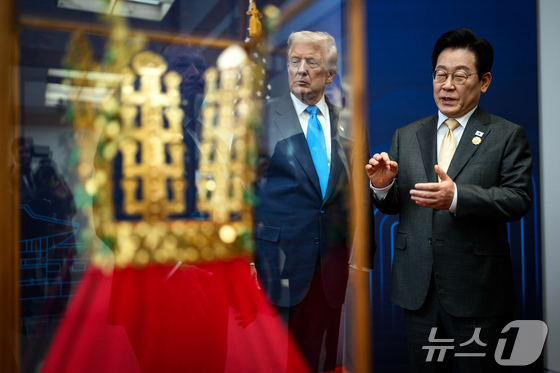
Throughout this process, Lee employed tailored diplomacy to appeal to Trump’s preferences. At their first summit in August, he lauded Trump as a peacemaker for the Korean Peninsula. During their second summit in Gyeongju in October, Lee presented Trump with a gold model of a Silla crown, treating him like royalty. Simultaneously, he publicly requested cooperation on nuclear-powered submarines, aligning with Trump’s transactional approach.
South Korea’s response to U.S. demands for increased defense spending was seen as consistent with its self-reliant defense policy. The U.S. insisted South Korea raise its defense budget to 3.5% of GDP, which South Korea addressed by agreeing to transition wartime operational control and increase purchases of U.S. weapons.
This concise yet significant U.S.-South Korea agreement was outlined in a joint fact sheet produced during the Gyeongju summit last October, serving as a guarantee. It included commitments to cooperate on revising the bilateral nuclear agreement regarding uranium enrichment and spent nuclear fuel reprocessing.
As the U.S. Pushes Investment, Nuclear Talks Stall and Trump Risk Lingers
However, the Trump risk remains a clear and present danger. In February, he criticized delays in South Korea’s legislation on U.S. investments and threatened to hike tariffs back to 25%. Meanwhile, the Trump administration has been lukewarm about practical discussions on nuclear submarines and nuclear energy agreements.
U.S. working-level talks on nuclear submarines and energy, initially set for January, have been repeatedly postponed with no firm date in sight. While the Middle East crisis is cited as the main reason, it’s hard to view this as an unavoidable circumstance, given that the conflict began with U.S. airstrikes.
Last month, the U.S. Supreme Court ruled that the Trump administration’s global mutual tariff policy, pursued under the International Emergency Economic Powers Act (IEEPA), was illegal. In response, Trump imposed global tariffs again under Section 122 of the Trade Act. To sidestep the 150-day limit of that law, his administration initiated Section 301 investigations against 16 countries, including South Korea and Japan. This section permits unlimited sanctions, including tariffs, against unfair foreign government actions, leading some analysts to warn that the risk has actually increased.
In diplomatic circles, many view the Trump administration’s approach as the commodification of alliances, fundamentally altering the U.S.-South Korea alliance. Previously, cooperation was based on shared values and strategic interests. Now, it has morphed into a transactional relationship, weighing costs and benefits for each issue. This shift suggests that U.S.-South Korea relations will remain in a precarious balance of stability and uncertainty for the foreseeable future.
Professor Min Jeong Hoon from the National Diplomatic Academy said the rules governing the alliance have been significantly disrupted, adding that the current approach risks undermining trust. He noted that, given South Korea’s relatively constrained position, it will need to find ways to maximize benefits while minimizing risks in both economic and security areas.