

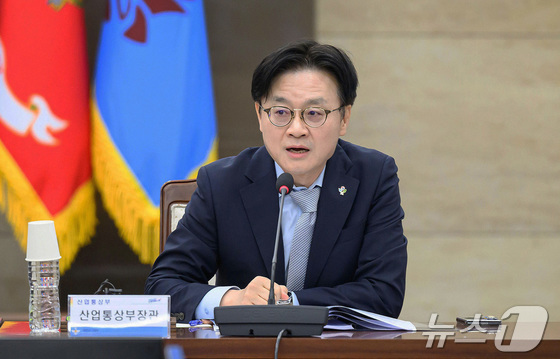
On June 5, Minister of Trade, Industry and Energy Kim Jung-kwan addressed concerns about the U.S. Trade Act Section 301 investigation into forced labor. He stated that while he as initially worried, U.S. Secretary of Commerce Howard Lutnick assured me that the tariff cap will remain at 15%, as agreed during last year’s summit.
Speaking on MBN News Wide, Minister Kim elaborated that Secretary Lutnick emphasized the importance of upholding the tariff and investment agreement package, which was built on mutual trust between the two nations’ leaders. He cautioned that if the U.S. were to impose tariffs above the 15% threshold, it would violate our agreement and potentially lead to more significant issues.
On June 2, the Office of the U.S. Trade Representative (USTR) unveiled plans to levy additional tariffs of 10% or 12.5% on 60 economies that have failed to effectively prevent the trade of goods produced through forced labor.
South Korea was among the 54 economies deemed inadequate in both implementing and enforcing import bans on forced labor products, making it subject to the 12.5% tariff.
Concerns have arisen that if both these measures and the ongoing U.S. Section 301 investigation into overproduction sectors result in tariffs, they could exceed the 15% cap agreed upon at last year’s South Korea-U.S. summit.
In response, Minister Kim confirmed through a video call with Secretary Lutnick that the previously agreed 15% tariff cap would be maintained.
Regarding U.S. investment progress, Minister Kim announced that the U.S. Investment Corporation will launch on June 18. He added that discussions are ongoing to ensure investment projects between the two countries offer strategic mutual benefits and commercial viability.
Reflecting on the government’s first year, Minister Kim highlighted their key achievement in trade relations. He noted that had it not reached the tariff agreement last year, it would have faced significant challenges early in the term. He emphasized their success in managing tariff risks through national interest-centered, practical diplomacy.
Kim also mentioned that while it’s still a sensitive issue, it’s managing the impacts of the Middle East conflict more effectively than many other countries. He added that the Manufacturing Artificial Intelligence (AI) Transformation (M.AX) policy, still in its early stages, is expected to show results in its second year.
During the interview, Minister Kim underscored the importance of the M.AX policy.
He explained that M.AX is crucial for our manufacturing sector to gain a competitive edge over China and other rivals in terms of productivity and overall competitiveness. Kim added that as the manufacturing workforce ages and new recruitment slows, integrating robotics and AI will help preserve workers’ tacit knowledge and skills, thereby maintaining our industrial competitiveness.