

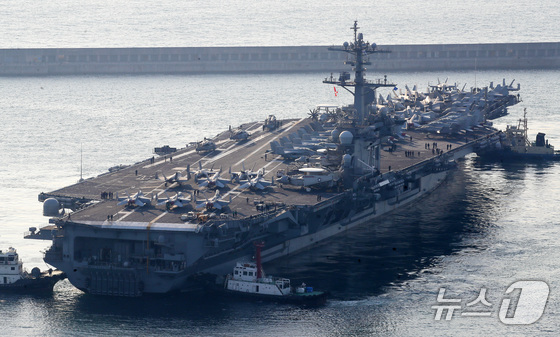
U.S. aircraft carrier deployments in the Pacific have significantly decreased following operations against Iran, potentially weakening deterrence against China, according to recent Japanese media reports.
The Nihon Keizai Shimbun, citing U.S. Naval Institute (USNI) data, reported on Thursday that U.S. carriers were deployed in the Indo-Pacific Command area for only about three weeks in January this year. This contrasts sharply with last year when two or more carriers maintained a presence for nearly 24 weeks during the same period.
Currently, the USS George Washington, homeported in Yokosuka, Japan, is the sole U.S. carrier operating in the Pacific. This single-carrier presence has persisted for 21 weeks since January, the longest such stretch since 2021.
The U.S. has committed three of its seven operational carriers to the Middle East following joint operations with Israel against Iran in late February. This reallocation has raised concerns about the military’s ability to conduct simultaneous operations in other regions, particularly East Asia.
The U.S. has long maintained a two-war doctrine, aiming to simultaneously engage in two conflicts in different regions.
Prior to the Iran conflict, the U.S. regularly deployed an additional carrier to the Pacific alongside the Yokosuka-based vessel, largely in response to China’s military expansion and potential Taiwan contingencies.
China has been rapidly enhancing its naval capabilities. In June last year, it deployed two carriers simultaneously in the Pacific for the first time, and in November, it commissioned its third carrier, the Fujian.
The Nikkei reports growing concern in Japan over the reduced U.S. naval presence in the Pacific. In response, Japan is prioritizing defense cooperation with regional allies like South Korea, Australia, and New Zealand. It’s also accelerating discussions on bolstering its own defense capabilities ahead of the year-end revision of its three key security documents: the National Security Strategy, National Defense Strategy, and Defense Build-Up Plan.