

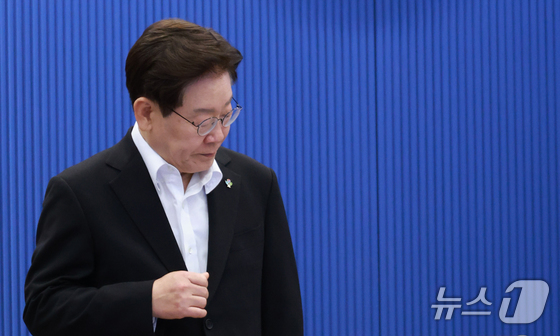
President Lee Jae Myung’s approval rating has plummeted to the early 50s, marking the lowest point since his inauguration.
A recent Gallup Korea poll, conducted from June 23-25 and surveying 1,000 eligible voters aged 18 and older, reveals that President Lee’s job performance approval rating now stands at 51%. This represents a significant 6-percentage point drop from the previous survey’s 57%. Conversely, his disapproval rating has surged by 6 percentage points to 41%.
This marks the second consecutive decline in President Lee’s approval rating in Gallup’s surveys. The percentage of positive evaluations is now at its lowest since his administration took office, while disapproval ratings have surpassed 40% for the first time.
The gap between approval and disapproval has narrowed to just 10 percentage points, a stark contrast to the 22-percentage point gap observed two weeks ago.
Regional disparities are evident, with Incheon and Gyeonggi (52%), Gwangju and Jeolla (75%), and Busan, Ulsan, and South Gyeongsang (49%) showing higher approval than disapproval rates. However, Daejeon, Sejong, and Chungcheong (46% approval, 49% disapproval) and Daegu and North Gyeongsang (32% approval, 57% disapproval) lean towards disapproval. Seoul remains divided, with 48% approval and 45% disapproval, within the margin of error.
Age demographics reveal a generational split, with those 30 and older generally approving of Lee’s performance. However, among 18-29 year-olds, disapproval (48%) significantly outweighs approval (36%) by 12 percentage points.
Supporters cite diplomacy (24%) and economic policies (15%) as reasons for their approval. Critics point to economic concerns and high exchange rates (15%), real estate issues and alleged election irregularities (10% each), and perceived avoidance of legal proceedings (9%) as grounds for disapproval.
President Lee’s average approval rating for his first quarter in office (April to June) stands at 63%, tying with former President Kim Dae-jung. This figure ranks second highest among recent presidents, trailing only former President Moon Jae-in’s 68%.
The Democratic Party maintains a steady 41% support rating, while the People Power Party has slipped 2 percentage points to 27%. Smaller parties like the Reform Party and Justice Party garnered 4% and 2% support, respectively.
This poll employed random sampling of virtual phone numbers for telephone interviews. The margin of error is ±3.1% at a 95% confidence level, with a response rate of 10.5%.
For comprehensive data and methodology, readers can visit the Central Election Polling Review Committee’s website.