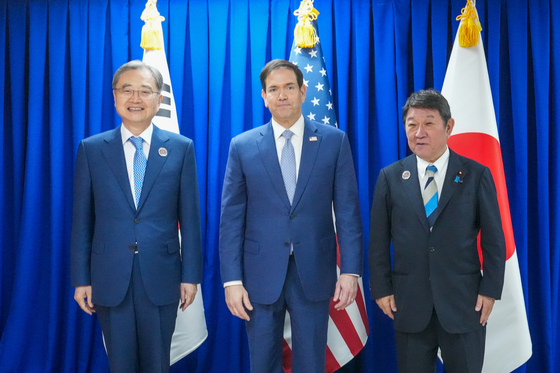
On Wednesday, the top diplomats of South Korea, the U.S., and Japan convened during the Association of Southeast Asian Nations (ASEAN)-related foreign ministers’ meeting to discuss key issues, including the situation on the Korean Peninsula, regional dynamics such as the South China Sea, and economic security cooperation. The three nations reaffirmed their commitment to maintaining a robust deterrence posture against North Korea while upholding the principles of denuclearization on the Korean Peninsula.
South Korean Foreign Minister Cho Hyun held a trilateral meeting with U.S. Secretary of State Marco Rubio and Japanese Foreign Minister Toshimitsu Motegi in Manila, Philippines. This gathering came about two weeks after their discussions on the sidelines of the North Atlantic Treaty Organization (NATO) summit on July 7.
Minister Cho noted that reconvening after just two weeks underscores the importance the three countries place on their cooperation. He emphasized the significance of sending a unified message to strengthen collaboration during the ASEAN-related meeting, which brought together major regional players. Both Secretary Rubio and Minister Motegi welcomed the meeting and expressed their commitment to enhancing trilateral cooperation and coordination.
The ministers shared assessments of the recent situation on the Korean Peninsula and reaffirmed their stance on denuclearization and a strong deterrence posture against North Korea. They agreed to maintain close coordination on North Korean policies while continuing communication and cooperation to achieve peace and stability on the peninsula through dialogue and diplomacy.
They also exchanged views on key regional and global situations, including Northeast Asia and the Middle East. The ministers concurred on the need to strengthen communication and policy coordination among their countries in response to the increasing uncertainties in the international landscape.
Notably, the three ministers discussed attempts to unilaterally change the status quo and reaffirmed their commitment to upholding international law, as reflected in the United Nations (UN) Convention on the Law of the Sea. This includes supporting freedom of navigation and overflight in the Indo-Pacific region, including Southeast Asia, as well as enhancing maritime security.
The phrase attempts to unilaterally change the status quo is typically used among South Korea, the U.S., and Japan to counter China’s influence in Southeast Asia. It is understood to refer to issues surrounding Taiwan and the territorial disputes in the South China Sea involving China and the Philippines.
While the South China Sea is a major security concern for ASEAN, differences among member states regarding their relations with China complicate a unified response. Recently, on the 10th anniversary of the international arbitration ruling that deemed China’s claims in the South China Sea to lack legal basis, the Philippines, the U.S., and Japan issued a joint statement, prompting China to denounce the ruling as illegal and invalid.
The three ministers also decided to actively pursue discussions to expand cooperation in areas such as transnational crime response, disaster relief, and humanitarian assistance, aiming for concrete and visible outcomes.
In the economic security sector, they emphasized the critical need for cooperation among reliable allies amid ongoing global economic volatility. The three countries agreed to deepen substantial cooperation based on their accumulated achievements and respective strengths in areas such as nuclear energy, critical minerals, and emerging technologies. They plan to expand collaboration in protecting advanced technologies, nuclear energy, diversifying and enhancing supply chain resilience, responding to economic coercion, and Arctic security, while continuing follow-up discussions.
The ministers committed to actively engaging in discussions across various sectors and levels, and to meet as frequently as possible during multilateral meetings and other occasions to maintain open lines of communication.