

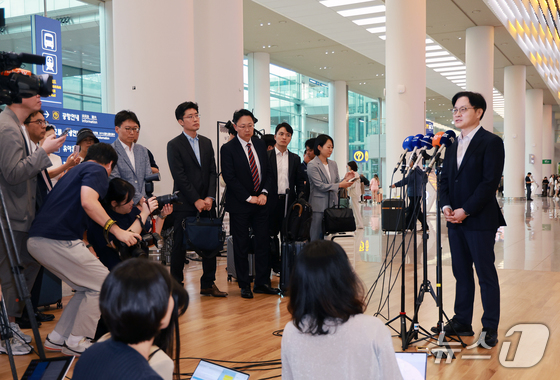
South Korea’s Minister of Trade, Industry and Energy, Kim Jeong-kwan, is set to return to the U.S., just 13 days after his last visit. While the specific purpose of this trip remains undisclosed, analysts speculate it could involve further discussions on U.S. investments and the implementation of tariff agreements. This comes as the selection of the first project in a 350 billion USD strategic investment initiative is imminent. With recent pressure from the U.S. regarding the pace of investment execution, many are watching closely to see if this visit will facilitate last-minute negotiations between the two countries.
Since Minister Kim’s previous visit, both countries have continued high-level face-to-face and virtual meetings to negotiate the selection of the first project. During his last trip, Kim met with U.S. Secretary of Commerce Gina Raimondo for two consecutive days, stating they had resolved many issues, but a final agreement remained elusive. The originally anticipated announcement timeframe of late August to early September has now been pushed back to sometime in September.
If high-level discussions occur during this visit, they will likely aim to narrow down the remaining issues from last month’s negotiations and finalize the specific conditions of the first project.
U.S. Pressure Over Implementation Pace Intensifies
The government announced on Tuesday that Minister Kim plans to visit the U.S. again, approximately 13 days after his last trip from August 16 to 19.
This visit is drawing significant attention primarily due to the recent resurgence of U.S. dissatisfaction with the pace of investment execution.
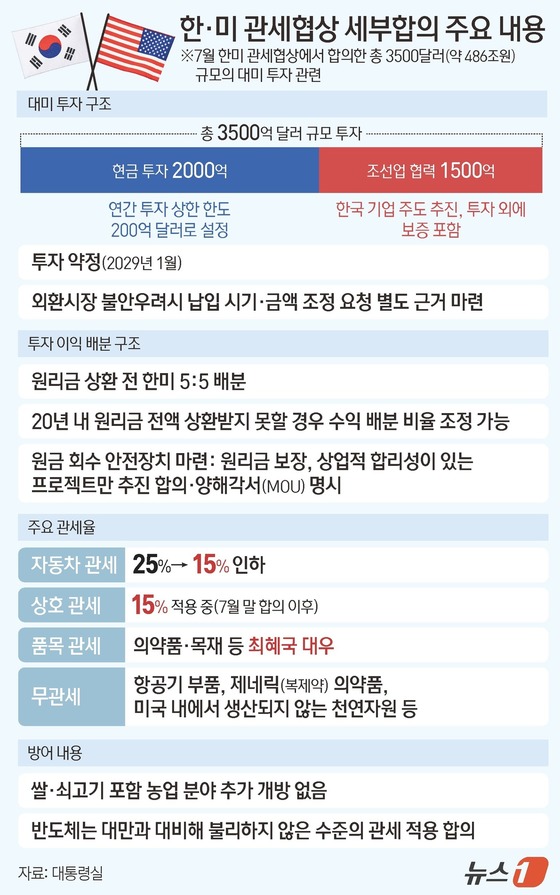
Last November, the U.S. and South Korea agreed to reduce tariffs on Korean products to 15% in exchange for South Korea committing to a 350 billion USD investment in the U.S. Of this amount, 150 billion USD is earmarked for cooperation in the shipbuilding sector, while the remaining 200 billion USD is slated for unspecified strategic investments.
While the shipbuilding cooperation is progressing separately, the individual investment projects for the remaining 200 billion USD have yet to be finalized or announced. Despite the South Korean government’s establishment of a legal framework for executing investments, including the enactment of a special law for U.S. investments and the launch of the Korea-U.S. Strategic Investment Corporation, negotiations surrounding specific conditions such as investment locations, amounts, profitability, and risk-sharing continue.
The U.S. has reportedly expressed a need to accelerate the pace of confirming these investment projects due to the delays. Earlier this year, President Donald Trump indicated he might raise tariffs on Korean products back to 25% due to delays in legislative implementation of the U.S.-Korea trade agreement.
With the domestic legislative process now completed, the speed at which actual investment projects are confirmed and executed has emerged as a key factor in the implementation of the U.S.-Korea agreement.
Remaining Issues Span Project Selection to Investment Terms
During his unplanned visit to the U.S. from August 16 to 19, Minister Kim met with Secretary Raimondo for two consecutive days to coordinate the selection of strategic investment projects.
Upon returning, Kim stated that while there were unresolved issues among working-level staff during negotiations, they had made significant progress through ministerial discussions. However, a final agreement remained out of reach, and they decided to seek common ground through additional virtual meetings.
The postponement of the first project announcement, originally expected between late August and early September, to sometime in September is likely linked to this additional coordination.
Currently, the negotiation issues may involve complex entanglements, from project selection to investment structures and conditions.
Energy Project No. 1 Emerges as Frontrunner Amid Investment Structure Debates
Reports indicate that the gas-fired combined cycle power plant in Encinada, Texas, is a strong contender for the first project. However, the government maintains that no specific project has been confirmed yet.
The government has publicly indicated that it is prioritizing the energy sector, considering the increasing electricity demand in the U.S. alongside the business viability for domestic companies. Minister Kim also noted after his last visit that discussions are focusing on the energy field.
However, it remains unclear what specific project the U.S. wants as the first initiative. Recent observations suggest the U.S. is pressuring South Korean semiconductor companies to invest in production facilities within its borders, raising questions about differing perspectives between the two countries on investment targets. Nevertheless, semiconductor investments have not been confirmed as a direct issue in the negotiations.
Ultimately, aligning the U.S.’s expectations for local production, employment, and supply chain strengthening with South Korea’s priorities for investment profitability and business viability will likely be a critical factor in the project selection process.
Another significant factor, as important as project selection, is the investment structure.
According to the U.S.-Korea Memorandum of Understanding (MOU), a special purpose vehicle (SPV) will manage the 200 billion USD strategic investment, with the U.S. or an entity designated by the U.S. overseeing it. The SPV for individual projects also includes language indicating it will be wholly-owned by the United States.
The interpretation of what U.S. ownership entails could influence how South Korean companies participate. There could be a difference in interpretation between requiring direct ownership by the U.S. government or a designated local entity and allowing participation from South Korean companies through locally established subsidiaries.
This interpretation could affect not only equity stakes but also decision-making structures, such as board membership and voting rights, as well as the allocation of business profits and conditions for recouping investments. For South Korea, ensuring the commercial viability of the project and the potential for recovering investments is crucial, especially given the need for substantial capital investment.
However, it has not been confirmed that the interpretation of U.S. ownership is the direct cause of the current negotiation delays. Various possibilities surrounding semiconductor investments and nuclear power cooperation have been mentioned, but the government has not disclosed the specific negotiation content.
U.S. Strategic Goals Clash with South Korea’s Commercial Interests
The core of the investment negotiations lies in bridging the gap between the strategic effects expected by the U.S. and the commercial viability demanded by South Korea.
For the U.S., it is crucial that South Korea’s substantial capital contributes to enhancing local production facilities and strengthening employment and supply chains. Conversely, South Korea must secure the recovery of its investment and profitability, given the long-term execution of a 350 billion USD investment.
This makes it essential to negotiate not only the project’s viability but also the investment scale, risk-sharing, and structures for operation and profit distribution.
Especially since the U.S. investment was tied to the tariff reductions agreed upon in last year’s U.S.-Korea trade agreement, it is difficult to view this matter separately from trade issues. The U.S. considers the pace of South Korea’s investment execution as a significant benchmark for compliance with the agreement, while South Korea recognizes that the outcomes of negotiations regarding investment conditions could impact future trade relations with the U.S.
In fact, during Minister Kim’s previous visit to the U.S., he also discussed additional tariff issues with representatives from the U.S. Trade Representative (USTR). He indicated that there was mutual understanding regarding the 15% tariff cap between the U.S. and South Korea.
If both sides meet again during this visit, there is a possibility that discussions could extend to the detailed conditions of the U.S. investment projects as well as the implementation of tariff agreements.
An official from the Ministry of Trade, Industry and Energy stated that both South Korea and the U.S. are conducting various consultations to identify U.S. investment projects, adding that specific projects have not yet been determined.
As the timeline for selecting the first project in September approaches, how much the two sides can narrow their remaining issues during this visit is expected to influence the pace of future U.S. investment negotiations.