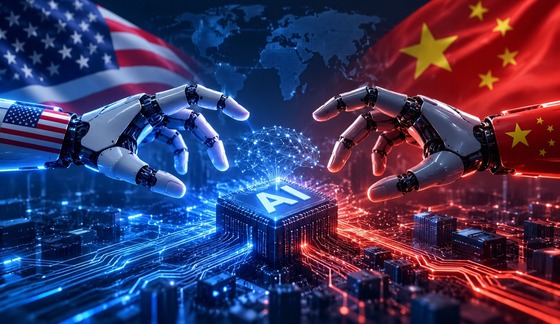
A claim has emerged from China asserting that the safety standards for artificial intelligence (AI) should not be unilaterally determined by the United States or specific companies. This statement openly challenges America’s leading role in establishing criteria for assessing the risks associated with cutting-edge AI.
On September 2, the Chinese state-affiliated social media account Yuyuan Tantian published an article arguing that humanity has fallen victim to an American-style disease. The post contended that the crucial question is not whether safety standards are necessary, but rather who should be responsible for setting the safety criteria for advanced AI models.
While Yuyuan Tantian is not an official government mouthpiece, it is known to convey the direction of China’s policies.
The issue raised by China centers on the safety standards for what is termed Frontier AI, referring to the most advanced and capable AI models currently in existence.
As AI capabilities rapidly advance, concerns have grown about their potential misuse in cyberattacks and other national security threats. Consequently, determining which level of AI capability should be deemed risky and under what circumstances development or distribution should be restricted has become a pressing international issue.
Yuyuan Tantian noted that when the U.S. and China discuss cooperation in the AI sector, managing frontier models will be a crucial agenda item. However, they emphasized the need to distinguish between actual security threats and technological competition between nations.
The account further stated that the U.S. has labeled China’s affordable and open models as a security threat, opposing a framework that evaluates the risks of Chinese AI based on U.S.-created standards and compels other countries and companies to follow suit.
Yuyuan Tantian argued that what is currently needed is not a definition unilaterally declared by a specific country or company, but a scientifically valid and mutually acceptable definition. They insisted that normal model development and commercial use should not be subject to interference.
The account stressed that such standards should be jointly established by all parties involved.
This assertion aligns with China’s recent AI policy stance.
In July, Chinese President Xi Jinping stated at the World Artificial Intelligence Conference (WAIC) that the advancement of AI should be a symphony played by the international community, not a solo performance by one nation. He emphasized that no single country should monopolize AI technology and rules.
The Chinese side argues that if the U.S. wants to emphasize AI safety, it must apply the same standards to American companies.
Yuyuan Tantian pointed out that the U.S. is already discussing measures to restrict China’s dangerous AI models, asserting that before demanding model distribution limits and risk disclosures from China, the U.S. should first investigate its own companies.
They further criticized the U.S. for remaining silent on data processing issues among American companies while only imposing safety standards on Chinese firms, arguing that this undermines the credibility of U.S. claims regarding AI safety.