President Donald Trump has simultaneously signaled potential deployment to the Hormuz Strait and military support for Ukraine. While some interpret this as broad pressure on South Korea to demonstrate its alliance commitment, analysts on Monday cautiously suggest a notable difference in the significance of these two issues.
The request for deployment to the Hormuz Strait represents a call for support in a conflict directly involving the U.S., indicating a push for substantial assistance. In contrast, the demand for military support for Ukraine seems more like a diplomatic move aimed at pressuring Russia to facilitate a smooth resolution to peace negotiations rather than a request for actual weapons.
In the ongoing Middle Eastern conflict, securing a strategic withdrawal requires allied support.
An anonymous senior U.S. administration official stated on September 4 in response to a News1 inquiry about discussions with South Korea regarding an Iranian deployment that South Korea is one of the largest importers of Middle Eastern oil. They’re still waiting for South Korea to deploy assets to the region.
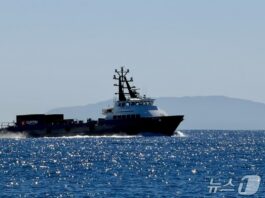
Since the early days of the conflict in March, the Trump administration has requested major countries, including South Korea, to send warships in response to Iran’s blockade of the Hormuz Strait, and has repeatedly called for the North Atlantic Treaty Organization (NATO) members to join. However, South Korea has avoided making a definitive stance and has refrained from intervention, while traditional U.S. allies like Germany have outright rejected direct requests.
Although U.S. pressure for participation seemed to ease following the start of peace negotiations in June, the demand for deployment has intensified recently as Iran and the U.S. failed to reach an agreement and resumed military hostilities.
President Trump, who promised an early end to the war, appears increasingly anxious as the conflict drags on and his approval ratings decline ahead of the November midterm elections. Some analysts believe that Trump, having lost control in the Hormuz Strait, is aggressively pushing a strategy to secure justification for the war through the deployment of many allies to pressure Iran for a ceasefire.
On August 30, Trump also expressed his blatant dissatisfaction with major allies, stating during an appearance on Fox News that it spend billions of dollars to help NATO and other countries, but it has received almost no help in return. South Korea is a prime example.
On the same day that a senior White House official demanded South Korea deploy assets to the Middle East, President Trump shared a Washington Post (WP) column titled, How Trump Can Help Ukraine Build Its Own Patriot Missiles, on social media.
The column’s author, Marc Thiessen, argued that Trump should pressure South Korea to sell its stockpile of M-SAM II (Cheongung-II) interceptor missiles, known as the Korean Patriot, to Ukraine.
Thiessen, a former speechwriter for President George W. Bush, serves as a senior fellow at the conservative American Enterprise Institute (AEI) and frequently appears on the pro-Trump network Fox News.
He criticized South Korea for not selling weapons to Ukraine while supplying Cheongung-II missiles to the United Arab Emirates (UAE), which was attacked by Iranian missiles in June, calling it outrageous. His logic suggests that the UAE, also a war-affected country, should not receive weapons while Ukraine does not.
This context leads to the interpretation that Trump’s sharing of the column serves as pressure for South Korea to support Ukraine with military aid.
Direct Korean Arms Support for Ukraine Is Not an Option—The U.S. Knows It, Too
Despite frequent discussions about military support for Ukraine since the onset of the war, no agreements have materialized due to South Korea’s laws restricting arms exports for reasons of international peace, security, and national defense.
Article 68, Section 7 of the Defense Acquisition Act stipulates that the Defense Acquisition Program Administration (DAPA) can restrict arms exports under circumstances such as when international peace and security or national security necessitate it, or when diplomatic friction is anticipated from the export of defense materials and defense technology. Ukraine likely falls under all these restricted circumstances.
Additionally, the Foreign Trade Act allows for the export of strategic materials, including weapons, only for peaceful purposes. The Cheongung missiles provided to the UAE were part of a contract for ten systems signed before the outbreak of conflict in January 2022, warranting a different perspective.
The U.S. is well aware of South Korea’s position. The Biden administration’s development of a roundabout support strategy reflects this understanding.
In 2022, the Biden administration provided Ukraine with 155mm artillery shells from its stockpile and purchased 100,000 shells from South Korea, effectively creating a three-way indirect support mechanism to fill the ammunition shortfall for Ukraine with South Korean products. Reports also indicate that in 2023, South Korea agreed to provide the U.S. with 500,000 155mm shells on a loan basis.
Despite this precedent, Trump’s sudden gesture suggesting South Korea support Ukraine with military aid highlights a message for South Korea to align with the U.S. on key issues.
In reality, Trump appears more focused on pressuring for a ceasefire agreement with Russia rather than influencing the military situation through aid to Ukraine. Trump’s special envoy Steve Witkoff and son-in-law Jared Kushner visited Moscow and Kyiv on September 5 and 6 to meet with President Vladimir Putin and President Volodymyr Zelenskyy respectively.
The South Korean government is reportedly prioritizing developing appropriate responses to the Hormuz deployment issue over matters related to Ukraine. It believes that narrowing differences and conflicts with the U.S. regarding the Hormuz deployment could expand South Korea’s maneuverability on other issues.