

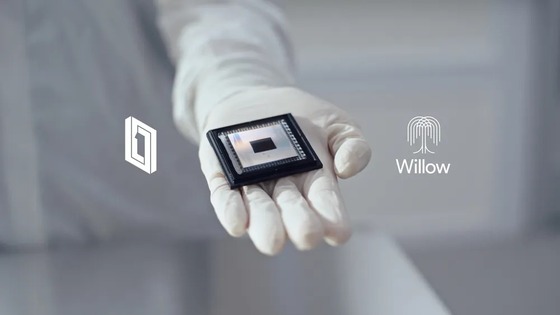
Google has achieved a major breakthrough in quantum computing by implementing a revolutionary algorithm on its superconducting quantum chip (QPU) Willow that dramatically reduces computational errors.
This advancement not only reinforces the unique operational strategies of quantum computing but also marks a significant step toward its commercial viability.
On Thursday, Google announced the publication of its research on measuring Out-of-Time-Order Correlators (OTOC) using Willow in the prestigious journal Nature on Wednesday.
This groundbreaking experiment explores the possibility of reversing and restoring dispersed quantum information to its original state.
In quantum circuits with numerous qubits, information dynamics become increasingly entangled over time, making it challenging to extract detailed information later. This entanglement is a root cause of persistent errors in quantum computing.
However, theoretical research has shown that OTOC measurements can preserve information in many-body quantum systems over extended periods.
This discovery paves the way for more precise and error-resistant quantum operations.
Google’s experiments demonstrated that Willow could process OTOC measurements in about two hours. In contrast, a supercomputer would require 37 quintillion operations, taking over three years to complete the same task.
Professor Han Jung-hoon from Sungkyunkwan University lauded the achievement, stating that this research is significant because it proves OTOC measurements in actual superconducting quantum circuits, not just in theory. Quantum computers have accomplished a computational feat that classical computers struggle to replicate, effectively demonstrating quantum supremacy through experimentation.
Analysts suggest that quantum computing giants like IBM are pivoting their strategies, moving away from the trend of simply scaling up physical qubits.
Professor Kwon Seok-jun from Sungkyunkwan University’s Department of Chemical Engineering explained that the quantum computing race has primarily focused on increasing physical qubit count and reducing overhead to boost the number of logical qubits for actual computations. However, practical quantum computing applications also require error resilience for stable long-term operations.
He added that even with similar physical qubit sizes and overhead ratios, a faster reduction of logical errors based on code distance can significantly enhance computational efficiency. Kwon praised Google’s new strategy for its potential to reduce logical error rates and increase logical qubit sizes in the medium to long term.
Kwon further noted that Google has redefined quantum advantage, showing it’s not just about raw computational speed, but also about leveraging the unique properties of quantum interference. This definitively demonstrates fundamental quantum computing capabilities that classical computers simply can’t simulate.
He predicted that Google may now focus more on addressing fundamental issues like quantum error correction, rather than just expanding physical qubit counts. South Korea, as an emerging player in quantum technology, should adopt a dual-track approach, balancing qubit expansion with quantum error correction (QEC) strategies.
Additionally, Google has announced follow-up research applying this measurement technique to life sciences and chemical research, including drug development. This work was pre-published on the arXiv platform. Specifically, it combines nuclear magnetic resonance (NMR) technology with quantum computing to analyze molecular structures.