On Friday, the Korea Advanced Institute of Science and Technology (KAIST) announced a breakthrough in image sensor technology. A research team led by Professor Jang Min Seok from the Department of Electrical and Electronic Engineering, in collaboration with Professor Jung Hae Jun’s team from Hanyang University, has developed innovative meta-material technology for image sensors. This advancement allows for stable color separation regardless of the angle of incident light.
Conventional smartphone cameras have relied on tiny lenses to focus light and capture images. However, as camera pixels have continued to shrink, these lenses alone have become insufficient to gather enough light.
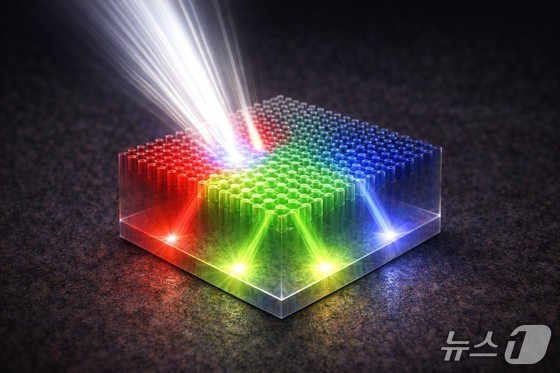
To address this limitation, researchers developed nano-photonic color routers. These devices use structures so minuscule they’re invisible to the naked eye, precisely separating incoming light by color instead of relying on lenses. This metamaterial-based technology meticulously designs light pathways to accurately split light into red, green, and blue (RGB) components.
Samsung Electronics has already demonstrated the real-world potential of this technology by incorporating it into image sensors under the name “nano prism.” Theoretically, stacking multiple layers of these ultra-fine nanostructures can enhance light collection and improve color separation accuracy.
Despite their promise, existing nano-photonic color routers faced a significant hurdle. While they performed admirably when light entered straight on, their effectiveness plummeted when light approached at an angle, resulting in color blending or severely diminished performance. This oblique incidence problem has been a major obstacle to practical implementation.
The research team first delved into the root cause of this issue. They discovered that previous designs were excessively optimized for perpendicular light entry, causing rapid performance degradation with even slight changes in the angle of incidence. Given that smartphone cameras capture light from various angles, maintaining consistent performance across different angles of light entry is crucial.
To overcome this challenge, the team employed a reverse engineering approach. Instead of relying on human design, they allowed a computer to autonomously determine the optimal structure. This method yielded a color router design that reliably separates colors, even with varying angles of incoming light.
While previous structures faltered at a tilt of just 12 degrees, the new design maintains approximately 78% optical efficiency and stable color separation performance across a 24-degree range. This level of performance is well-suited to real-world smartphone applications.
The team also conducted a comprehensive analysis of performance variations, taking into account factors such as the number of meta-material layers, design parameters, and potential manufacturing errors. They systematically outlined the limits of the technology’s robustness against changes in the angle of incidence.
Professor Jang emphasized the significance of the research, saying that their work represents the first systematic analysis and solution to the angle of incidence problem that has long hindered the commercialization of color router technology, and added that the proposed design methodology has potential applications beyond color routers, extending to various meta-material-based nano-optical devices.
This groundbreaking research, co-authored by KAIST undergraduate student Jeon Jae Hyun and doctoral candidate Park Chan Hyung, has been published in the prestigious international journal Advanced Optical Materials.